Inverse proportionality
An SAT Math micro-topic under Unit Conversion (Problem solving and data analysis). Free to read — no account needed.
In an inverse relationship, the product of the two quantities never changes.
So if , making one bigger forces the other smaller.
They can never both be large at the same time.
So if , making one bigger forces the other smaller.
They can never both be large at the same time.
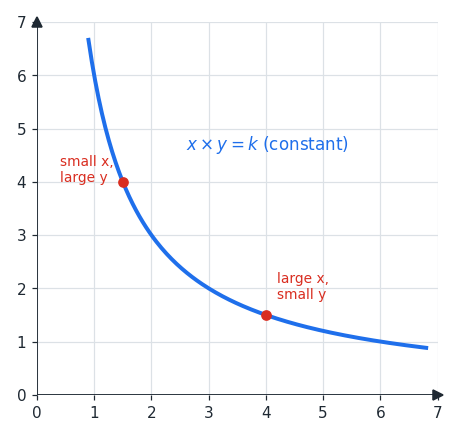
The graph of an inverse relationship is a curve that drops steeply and then levels off.
As gets larger, gets smaller so that the product stays the same.
The curve never touches either axis.
As gets larger, gets smaller so that the product stays the same.
The curve never touches either axis.
The key rule is that a change in one quantity is undone in the other.
If one is multiplied by , the other is divided by .
That keeps their product equal to the same constant .
If one is multiplied by , the other is divided by .
That keeps their product equal to the same constant .
Sometimes the constant involves a power, like .
If is multiplied by , then must be divided by to keep the same.
Since is divided by , itself is divided by , because .
If is multiplied by , then must be divided by to keep the same.
Since is divided by , itself is divided by , because .
Worked examples
If and are inversely proportional with , and is tripled, what happens to ?
To keep the product at , must be divided by .
So if was , it becomes .
To keep the product at , must be divided by .
So if was , it becomes .
The time to fill a pool is inversely proportional to the number of pumps. With pumps it takes hours. How long with pumps?
The product stays constant: .
With pumps, , so the time is hours.
The product stays constant: .
With pumps, , so the time is hours.
In , if is multiplied by , by what factor does change?
To keep constant, must be divided by .
Since is divided by , is divided by , because .
To keep constant, must be divided by .
Since is divided by , is divided by , because .
Is this one of the topics costing you points?
Take the free 10-question diagnostic for a predicted SAT score and a breakdown of which domains are costing you points.