Questions based on direct proportionality
An SAT Math micro-topic under Unit Conversion (Problem solving and data analysis). Free to read — no account needed.
Two quantities are directly proportional when they increase and decrease together at a steady rate.
If one doubles, the other doubles; if one is halved, the other is halved.
For example, if 1 pen costs $5, then 5 pens cost $25 and 10 pens cost $50.
If one doubles, the other doubles; if one is halved, the other is halved.
For example, if 1 pen costs $5, then 5 pens cost $25 and 10 pens cost $50.
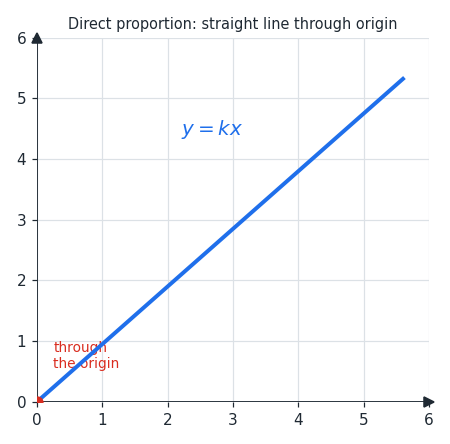
The graph of a direct proportion is a straight line through the origin.
As one quantity increases, the other increases in step, keeping their ratio constant.
When one quantity is zero, so is the other.
As one quantity increases, the other increases in step, keeping their ratio constant.
When one quantity is zero, so is the other.
To solve, put the two situations on separate rows, then cross-multiply across them.
Cross-multiplying gives , so , meaning 5 pens cost $25.
The first row does not have to start with 1.
The method is the same whatever the starting number.
Cross-multiplying gives , so .
The method is the same whatever the starting number.
Worked examples
If 1 apple costs $2, how much do 6 apples cost?
Cross-multiply: , so dollars.
If 3 notebooks cost $18, how much do 7 notebooks cost?
Cross-multiply: , so dollars.
If 2 grams of paint cover 1 square cm, how much paint covers 616 square cm?
Cross-multiply: , so grams.
Is this one of the topics costing you points?
Take the free 10-question diagnostic for a predicted SAT score and a breakdown of which domains are costing you points.