An SAT Math micro-topic under Unit Conversion (Problem solving and data analysis). Free to read — no account needed.
A conversion factor links two units, like 1 meter =100 centimeters. To change into a smaller unit you multiply (a meter is many centimeters), and to change into a larger unit you divide.
Some common factors are worth knowing. For length, 1 m =100 cm =1000 mm and 1 km =1000 m. For time, 60 seconds =1 minute and 60 minutes =1 hour. For volume, 1 liter =1000 milliliters.
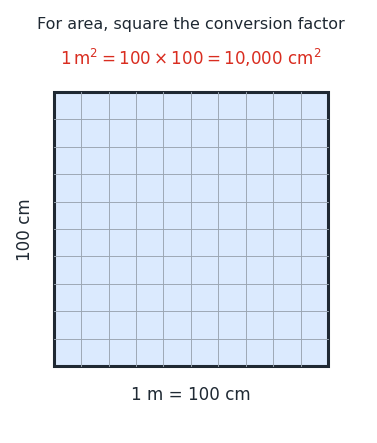
Area and volume are the classic trap. Since an area is a length times a length, you must square the conversion factor: because 1 m =100 cm, 1 m² =100×100=10,000 cm². For volume you cube it, so 1 m³ =1,000,000 cm³.
Angles convert between degrees and radians using π radians=180∘. To go from degrees to radians, multiply by 180π; the other way, multiply by π180. For example, 60∘×180π=3π.
Very large numbers are easiest as powers of 10. One million is 106, one billion is 109, and one trillion is 1012. So 2.8 trillion is 2.8×10¹².
Worked examples
How many millimeters are in 45.6 meters? There are 1000 millimeters in a meter, and millimeters are smaller, so multiply. So 45.6×1000=45,600 millimeters.
Given that 1 yard =3 feet, how many square feet are in 1 square yard? Area means you square the conversion factor. So 1 yd2=32 ft2=9 square feet.
Convert 4π radians to degrees. To go from radians to degrees, multiply by π180. So 4π×π180=4180=45∘.
Is this one of the topics costing you points?
Take the free 10-question diagnostic for a predicted SAT score and a breakdown of which domains are costing you points.