An SAT Math micro-topic under Area and volume (Geometry and trigonometry). Free to read — no account needed.
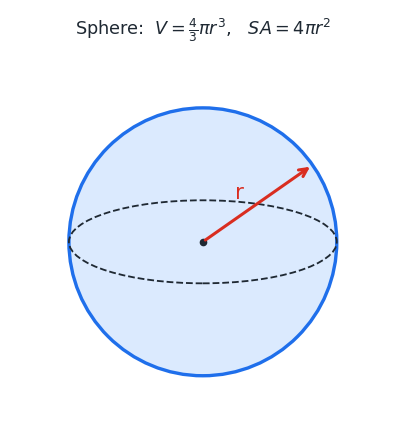
A sphere is a perfectly round three-dimensional shape, like a ball. Every point on its surface sits the same distance from the center. That distance is the radius, written r.
The diameter is the full width across the sphere through the center. It is always twice the radius: diameter=2r. So if you are told the diameter, halve it to get the radius: r=2diameter.
The volume (space inside) is V=34πr3. For a sphere with radius 3, the volume is 34π(3)3=34π(27)=36π. Notice the radius is cubed, so always work out r3 first.
The surface area (the outside skin) is SA=4πr2. Here the radius is squared, not cubed. Keeping these two formulas straight is the main thing this topic tests.
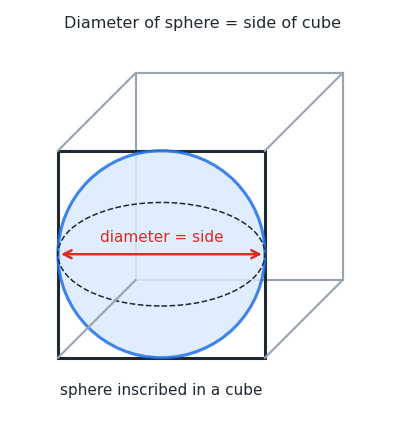
One common setup is a sphere that fits snugly inside a cube. The sphere touches each face of the cube, so its diameter equals the side length of the cube. That lets you find the radius as half the cube's side.
Worked examples
Find the volume of a sphere with radius 2. Use V=34πr3 with r=2. So V=34π(2)3=34π(8)=332π.
Find the surface area of a sphere with radius 3. Use SA=4πr2 with r=3. So SA=4π(3)2=4π(9)=36π.
A sphere is inscribed inside a cube with side length 10. What is the sphere's radius? An inscribed sphere touches every face, so its diameter equals the cube's side, 10. The radius is half the diameter: r=210=5.
Is this one of the topics costing you points?
Take the free 10-question diagnostic for a predicted SAT score and a breakdown of which domains are costing you points.