An SAT Math micro-topic under Area and volume (Geometry and trigonometry). Free to read — no account needed.
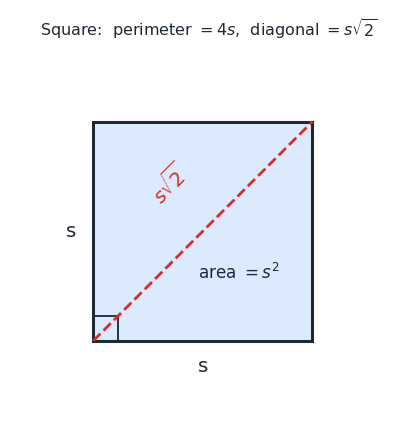
A square is a four-sided shape where all four sides are equal and all four angles are right angles (90∘). Because the sides are equal, everything about a square depends on one number: the side length s.
The perimeter is the distance around, so it is 4s. The area is the space inside, which is s×s=s2. For example, a square with side 5 has perimeter 20 and area 25.
The diagonal joins two opposite corners. It splits the square into two right triangles with legs s and s. By the Pythagorean theorem, the diagonal is s2+s2=2s2=s2. So a square with side 3 has a diagonal of 32.
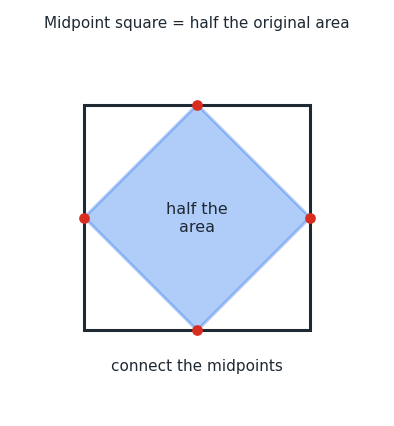
A useful pattern: connect the midpoints of a square's four sides to make a new, smaller square. The new square always has exactly half the area of the original. Its side is the original side divided by 2.
These facts show up in area questions, in geometry with right triangles, and in patterns where a square keeps getting subdivided. Knowing that area is s2 lets you jump between a square's side and its area in one step.
Worked examples
A square has a perimeter of 40. What is its area? The perimeter is 4s=40, so the side is s=10. The area is s2=102=100.
A square has a side length of 4. How long is its diagonal? The diagonal of a square is s2. So it is 42.
A square has an area of 16. The midpoints of its sides are joined to form a new square. What is the area of the new square? Joining the midpoints always gives half the area. So the new square has area 216=8.
Is this one of the topics costing you points?
Take the free 10-question diagnostic for a predicted SAT score and a breakdown of which domains are costing you points.