Circle equations
How the SAT tests this, with worked examples — plus the 2 skills it covers. Free to read, no account needed.
A circle is the set of points a fixed distance from a fixed centre, and its standard equation says exactly that
where is the centre and the radius.
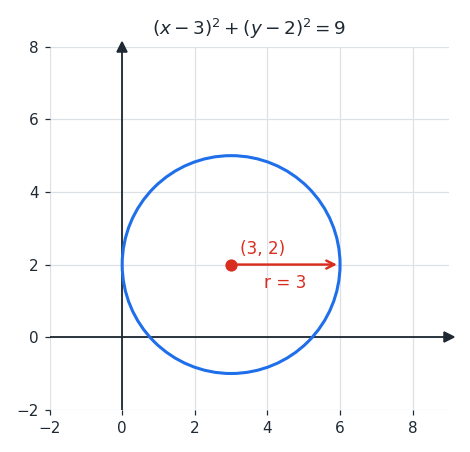
Read the signs carefully. The equation contains , so puts the centre at , while puts it at . The right-hand side is , not , so means a radius of .
When a question gives an expanded equation such as , it is asking you to complete the square in and in separately to recover the standard form.
Take half the coefficient of , square it, and add it to both sides; then repeat for . Everything else follows from reading and once the equation is in standard form.
Worked examples
Give the centre and radius of .
Matching the standard form, and , because is . Since , the radius is . So the centre is with radius .
Matching the standard form, and , because is . Since , the radius is . So the centre is with radius .
Find the centre of .
Complete the square in each variable
Complete the square in each variable
which gives , so the centre is and the radius .
Is circle equations costing you points?
Take the free 10-question diagnostic for a predicted SAT score and a breakdown of which domains are costing you points.