Data inferences
How the SAT tests this, with worked examples — plus the 3 skills it covers. Free to read, no account needed.
These questions take a result measured on a sample and ask what can honestly be said about the whole population. Two ideas carry nearly all of them.
The first is the margin of error. A survey never reports a single exact figure for a population; it reports an interval of plausible values around the estimate.
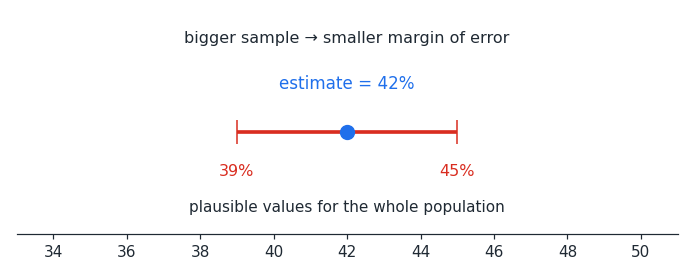
An estimate of with a margin of error of means the true population value is plausibly anywhere from to . So a claim that the true value is exactly is unsupported, while a claim that it is at least is defensible.
Margin of error shrinks as the sample grows. It says nothing about whether the sample was any good — only how precise the estimate is for its size.
The second idea is random selection, and it decides whether an inference is allowed at all. Results generalise only to the population the sample was randomly drawn from. A random sample of one school's students supports conclusions about that school, not about the country.
Worked examples
A poll estimates {58
%} support with a margin of error of {4
%}.
%} support with a margin of error of {4
%}.
Which conclusion is best supported?
- AExactly {58
%} of the population supports it.
(B) Plausible values for population support run from {54
%} to {62
%}.
The interval is the whole reason a margin of error is reported, so (B) is correct. (A) treats a sample estimate as an exact population value.
(B) Plausible values for population support run from {54
%} to {62
%}.
The interval is the whole reason a margin of error is reported, so (B) is correct. (A) treats a sample estimate as an exact population value.
Researchers randomly select members of one gym and find {40
%} attend daily.
%} attend daily.
What may be concluded?
- AAbout {40
%} of people nationally attend a gym daily.
(B) About {40
%} of that gym's members attend daily.
The sample was drawn at random from one gym's membership, so only that population supports an inference, making (B) correct.
(B) About {40
%} of that gym's members attend daily.
The sample was drawn at random from one gym's membership, so only that population supports an inference, making (B) correct.
A study repeats a survey with times as many people.
What happens to the margin of error?
It gets smaller, because margin of error falls as sample size rises. Note that this improves precision only. If the larger sample was still selected badly, the estimate stays biased — just more precisely so.
What happens to the margin of error?
It gets smaller, because margin of error falls as sample size rises. Note that this improves precision only. If the larger sample was still selected badly, the estimate stays biased — just more precisely so.
Is data inferences costing you points?
Take the free 10-question diagnostic for a predicted SAT score and a breakdown of which domains are costing you points.