Probability and relative frequency
How the SAT tests this, with worked examples — plus the 2 skills it covers. Free to read, no account needed.
Probability on the SAT is counting, not theory. Almost every question is
and the difficulty lies entirely in deciding which numbers those are.
The data nearly always arrives as a two-way table, and the trick is reading which part of the table the question restricts you to.
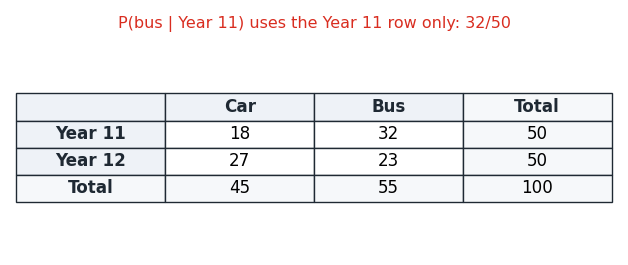
If a question asks for the probability that a randomly chosen student takes the bus, the denominator is everyone: . But if it asks for the probability given that the student is in Year 11, you are confined to the Year 11 row, so it is .
That word given is the whole question. It tells you to shrink the denominator from the grand total to a single row or column. Missing it is the most common error in this topic.
Relative frequency is the same calculation applied to observed data rather than theory: the proportion of times something actually happened. The SAT uses it to ask whether a sample's results can be extended to a wider population, which they can only when the sample was selected at random.
Worked examples
Using the table above, what is the probability a randomly chosen student travels by car?
The denominator is the grand total, because no restriction was given
The denominator is the grand total, because no restriction was given
What is the probability that a student travels by car, given that they are in Year 12?
- A
- B
The word given restricts you to the Year 12 row, whose total is . So the answer is , making (B) correct. Choice (A) is the trap of keeping the grand total as the denominator.
In a random sample of shoppers, bought fruit. The shop serves customers a week.
Estimate how many buy fruit.
The relative frequency is , and because the sample was random it can be applied to the whole population
Estimate how many buy fruit.
The relative frequency is , and because the sample was random it can be applied to the whole population
Had the sample not been random, no such estimate would be justified — and that is usually the correct answer choice when it appears.
Is probability and relative frequency costing you points?
Take the free 10-question diagnostic for a predicted SAT score and a breakdown of which domains are costing you points.