Radical, rational, and absolute value equations
How the SAT tests this, with worked examples — plus the 3 skills it covers. Free to read, no account needed.
These three equation types share one feature: the step that removes the awkward part can introduce answers that do not actually work, so checking is part of the method rather than an optional extra.
An absolute value equation splits into two cases, because the expression inside can be positive or negative.
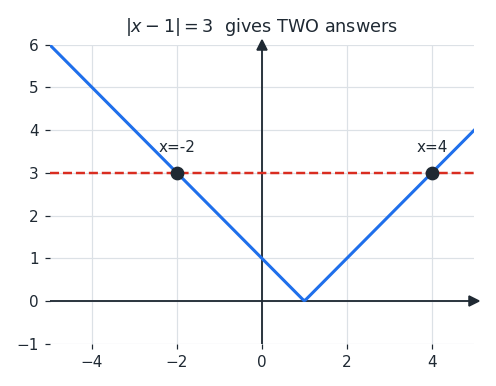
So gives and , hence and . Giving only one answer is the standard mistake. Note also that has no solution at all, since a distance cannot be negative.
A radical equation is solved by squaring both sides, but squaring can create extraneous solutions — values that satisfy the squared equation but not the original. Always substitute your answers back.
A rational equation is solved by multiplying through by the denominators, with the same caution: any value that makes a denominator zero must be rejected, because the original expression is undefined there.
Worked examples
Solve .
Split into two cases
Split into two cases
Both are genuine solutions.
Solve .
Square both sides to get , so and , giving or . Checking: works, but fails. Only is a solution — is extraneous.
Square both sides to get , so and , giving or . Checking: works, but fails. Only is a solution — is extraneous.
Why must be rejected in ?
Because makes the denominator zero, so the original expression is undefined there — regardless of what the rearranged equation produces.
Because makes the denominator zero, so the original expression is undefined there — regardless of what the rearranged equation produces.
Is radical, rational, and absolute value equations costing you points?
Take the free 10-question diagnostic for a predicted SAT score and a breakdown of which domains are costing you points.