Solving quadratic equations
How the SAT tests this, with worked examples — plus the 2 skills it covers. Free to read, no account needed.
A quadratic has the form , and there are three ways to solve one. Picking the right method is most of the speed.
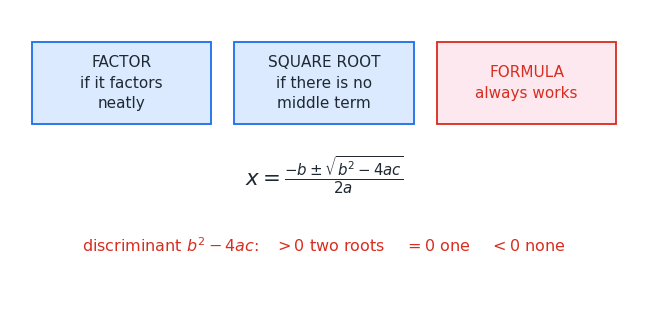
Factoring is fastest when the numbers are friendly. Rewrite as a product equal to zero, then set each factor to zero.
Square rooting works when there is no middle term. From you get , and forgetting the negative root is the most common error on the whole topic.
The quadratic formula always works
so use it whenever factoring is not obvious within a few seconds.
The expression under the root, , is the discriminant, and it tells you how many real solutions exist before you solve: positive gives two, zero gives one, negative gives none. Questions asking for a constant that makes an equation have exactly one solution are asking you to set it to zero.
Worked examples
Solve .
It factors neatly, so use that
It factors neatly, so use that
Solve .
There is no middle term, so isolate and square root — keeping both signs
There is no middle term, so isolate and square root — keeping both signs
How many real solutions does have?
Compute the discriminant rather than solving
Compute the discriminant rather than solving
It is negative, so there are no real solutions.
Is solving quadratic equations costing you points?
Take the free 10-question diagnostic for a predicted SAT score and a breakdown of which domains are costing you points.