Solving systems of linear equations
How the SAT tests this, with worked examples — plus the 5 skills it covers. Free to read, no account needed.
A system is two equations that must hold at the same time. Graphically, the solution is the point where the lines cross.
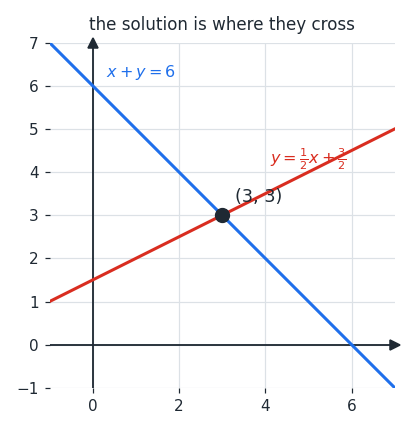
There are two reliable methods. Substitution suits a system where one variable is already alone: rearrange one equation for that variable and put the expression into the other. Elimination suits a system where the same variable has matching or opposite coefficients: add or subtract the equations so one variable disappears.
Neither method is better in general. Look at the coefficients and pick whichever requires less rearranging.
As with single equations, the number of solutions matters. The lines cross once when the slopes differ, never when the slopes match but the intercepts do not, and everywhere when the two equations describe the same line.
So a question asking for the value of a constant that makes a system have no solution is asking you to make the slopes equal while keeping the lines distinct.
Worked examples
Solve and .
The second equation already gives , so substitute
The second equation already gives , so substitute
Then , so the lines cross at .
Solve and .
The coefficients are opposites, so adding eliminates
The coefficients are opposites, so adding eliminates
Substituting back gives . Elimination was faster here because no rearranging was needed.
For what value of does and have no solution?
No solution needs parallel lines, so the coefficients must be proportional: doubling the first equation gives . So , and since the lines are distinct rather than identical.
No solution needs parallel lines, so the coefficients must be proportional: doubling the first equation gives . So , and since the lines are distinct rather than identical.
Is solving systems of linear equations costing you points?
Take the free 10-question diagnostic for a predicted SAT score and a breakdown of which domains are costing you points.