Basic exponentials
An SAT Math micro-topic under Quadratic and exponential word problems (Advanced Math). Free to read — no account needed.
An exponential function is written , where the variable appears in the exponent. Its defining feature is that increasing by multiplies by the constant factor , instead of adding a fixed amount as a straight line would.
Whether the curve grows or decays depends on . When each step multiplies by more than one, so the values rise faster and faster: exponential growth. When each step multiplies by less than one, so the values shrink towards zero without ever reaching it: exponential decay. Both curves pass through .
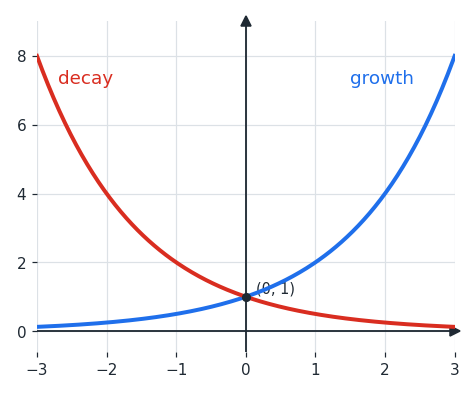
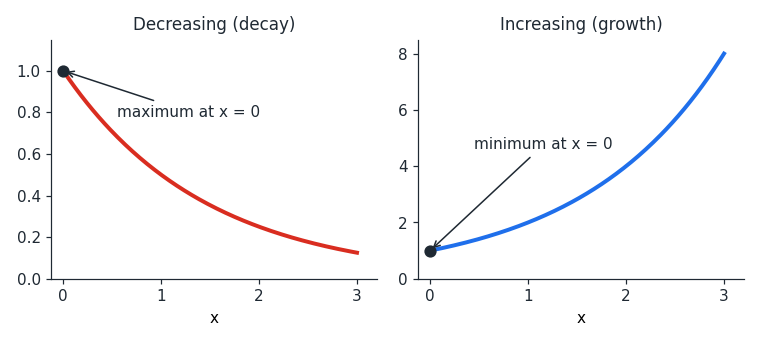
A useful consequence: because an exponential never turns around, on a domain that starts at its largest or smallest value always sits at . A decreasing (decay) function takes its maximum at , while an increasing (growth) function takes its minimum at — in each case that value is the starting amount .
This multiplicative behaviour is why percentage change is exponential. A quantity decaying per hour is multiplied by each hour, not reduced by a flat amount, so its graph curves rather than falling in a straight line.
Worked examples
A g sample decays per hour, so each hour it is multiplied by : after one hour g, and after two hours g. The drop is not a flat g each hour, which is what makes it exponential rather than linear.
For the growth function , the starting value at is , and every increase of in doubles : So is multiplied by at each step rather than having a fixed amount added.
Consider the decay function for . Its value is largest at the start: at , , and it only decreases afterwards, so its maximum is at . A growth function behaves the opposite way, taking its minimum at .
Is this one of the topics costing you points?
Take the free 10-question diagnostic for a predicted SAT score and a breakdown of which domains are costing you points.