Exponential growth and decay
An SAT Math micro-topic under Quadratic and exponential word problems (Advanced Math). Free to read — no account needed.
Exponential growth and decay follow the model : a starting amount multiplied by a factor once per period . The single number decides everything about the shape.
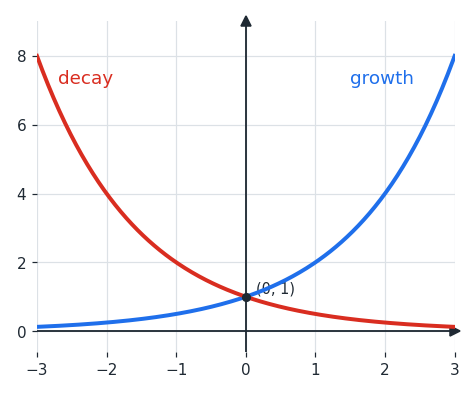
The graph shows both cases. When the curve rises faster and faster (growth); when it falls toward zero (decay). Both pass through the starting amount at .
To get the factor from a rate, add a percent increase to or subtract a percent decrease from . Growth of per year means ; decay of per year means keeping , so .
When the period is not one unit of time, put the number of periods in the exponent. If a population doubles every years, then after years it has doubled times, giving .
Worked examples
A colony of bacteria triples every hour. How many are there after hours?
Multiply by each hour: .
Multiply by each hour: .
A $1200 laptop loses of its value each year. What is it worth after years?
Keeping each year means : .
Keeping each year means : .
Does represent growth or decay?
The base is , and since , the quantity shrinks each step — it is exponential decay.
The base is , and since , the quantity shrinks each step — it is exponential decay.
Is this one of the topics costing you points?
Take the free 10-question diagnostic for a predicted SAT score and a breakdown of which domains are costing you points.