finding minimum/maximum in quadratics
An SAT Math micro-topic under Quadratic and exponential word problems (Advanced Math). Free to read — no account needed.
In vertex form , a quadratic's extreme value is easy to read off. The squared part is always , so it is smallest (zero) exactly at , which is where the maximum or minimum occurs.
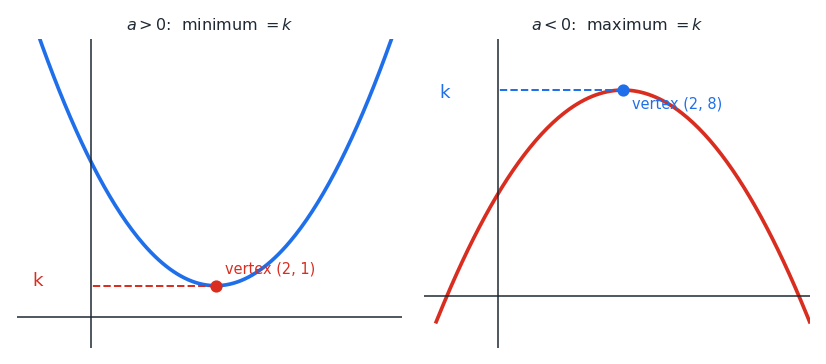
The figure shows both cases. When the parabola opens upward and the vertex is the lowest point, so is the minimum. When it opens downward and the vertex is the highest point, so is the maximum.
Here is why: since , multiplying by a positive keeps it , so (minimum ); multiplying by a negative makes it , so (maximum ).
If the quadratic is expanded instead, the sign of the coefficient still tells the direction: positive opens up (a minimum), negative opens down (a maximum). For , the coefficient is negative, so is the maximum.
Worked examples
What is the minimum value of ?
Since , the smallest it can be is , at .
So the minimum value is .
Since , the smallest it can be is , at .
So the minimum value is .
What is the maximum value of ?
Since and it is multiplied by , the term .
So is largest when that term is , at , giving a maximum of .
Since and it is multiplied by , the term .
So is largest when that term is , at , giving a maximum of .
A fountain's height is . What is its maximum height?
Expand: .
The coefficient is negative, so the maximum is the constant , reached at .
Expand: .
The coefficient is negative, so the maximum is the constant , reached at .
Is this one of the topics costing you points?
Take the free 10-question diagnostic for a predicted SAT score and a breakdown of which domains are costing you points.