An SAT Reading & Writing micro-topic under Boundaries (Expression of Ideas + Standard English Conventions). Free to read — no account needed.
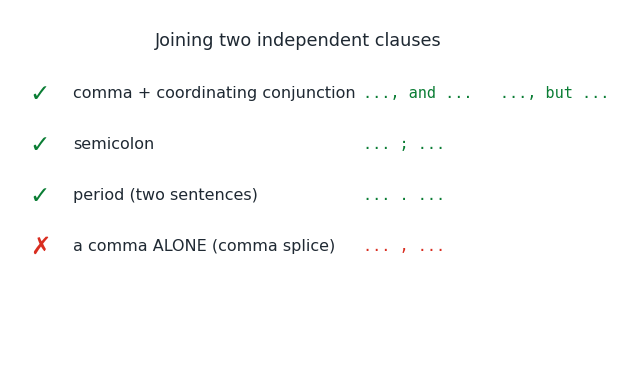
An independent clause is a group of words that could stand alone as a complete sentence. When you put two of them together, you must join them in a correct way, or the sentence is a run-on. There are a few valid joiners.
The most common join is a comma plus a coordinating conjunction — the words for, and, nor, but, or, yet, so (FANBOYS). For example: "The band broke up in 1970, but their music still sells today." Notice the comma comes before the conjunction.
You can also join two independent clauses with a semicolon and no conjunction: "The band broke up in 1970; their music still sells today." Or you can simply use a period and make them two separate sentences.
The one thing you cannot do is join them with a comma alone. "The band broke up in 1970, their music still sells today" is a comma splice, which is incorrect. A comma is too weak to hold two complete sentences together by itself.
Watch out for words like however and therefore. They are not conjunctions, so they cannot join clauses with just a comma; they need a semicolon before them and a comma after. And subordinating words like while, because, and although make a clause dependent, which follows different rules.
Worked examples
Which choice correctly joins the two independent clauses? "Silent films relied on visual storytelling ______ they still moved audiences deeply." (A) a comma (B) a semicolon Both parts are complete sentences and there is no conjunction, so a comma alone would be a comma splice. A semicolon can join two independent clauses on its own, so (B) is correct.
Which choice correctly joins the two independent clauses? "The rocket launched at dawn ______ the crowd cheered loudly." (A) , and (B) and When a coordinating conjunction like "and" joins two independent clauses, it needs a comma before it. So (A), a comma plus "and", is correct.
Which choice correctly joins the two independent clauses? "The plan was risky ______ however, the team pressed on." (A) ; (a semicolon) (B) , (a comma) "However" is not a coordinating conjunction, so a comma cannot hold the two clauses together. A semicolon is needed before "however", so (A) is correct.
Is this one of the topics costing you points?
Take the free 10-question diagnostic for a predicted SAT score and a breakdown of which domains are costing you points.