An SAT Reading & Writing micro-topic under Boundaries (Expression of Ideas + Standard English Conventions). Free to read — no account needed.
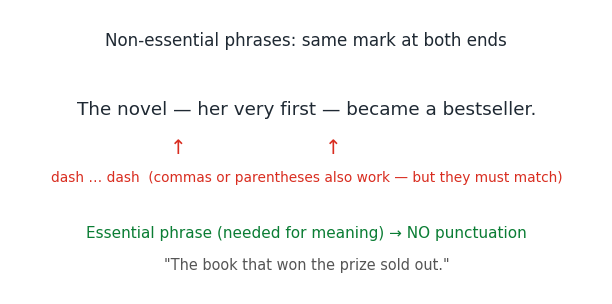
A phrase is non-essential when the sentence still makes sense with it removed. Such a phrase is set off with punctuation at both ends: a pair of commas, a pair of dashes, or a pair of parentheses.
For example, in "The Eiffel Tower, built in 1889, draws millions of visitors", the phrase "built in 1889" is extra detail. Remove it and the sentence still stands, so it is set off with commas.
The two marks must match. If a non-essential phrase begins with a dash, it must end with a dash, not a comma. Mixing a comma at one end and a dash at the other is an error.
An essential phrase, by contrast, is needed to identify or complete the meaning, so it gets no punctuation. In "The book that won the prize sold out", the phrase "that won the prize" tells you which book, so removing it would change the meaning. No commas or dashes belong around it.
Worked examples
Which choice correctly punctuates the sentence? "The Great Wall of China ______ built over many centuries, is visible for thousands of miles." (A) a comma (B) a dash The non-essential phrase "built over many centuries" ends with a comma, so it must also begin with a comma to match. So (A), a comma, is correct.
Which choice correctly punctuates the sentence? "The scientist ______ who discovered the vaccine received worldwide praise." (A) no punctuation (B) a comma The phrase "who discovered the vaccine" is essential, since it identifies which scientist, so it takes no punctuation. So (A), no punctuation, is correct.
Which choice correctly punctuates the sentence? "Her latest film — a three-hour epic ______ won every major award." (A) a dash (B) a comma The non-essential phrase "a three-hour epic" begins with a dash, so it must end with a dash to match. So (A), a dash, is correct.
Is this one of the topics costing you points?
Take the free 10-question diagnostic for a predicted SAT score and a breakdown of which domains are costing you points.