An SAT Reading & Writing micro-topic under Boundaries (Expression of Ideas + Standard English Conventions). Free to read — no account needed.
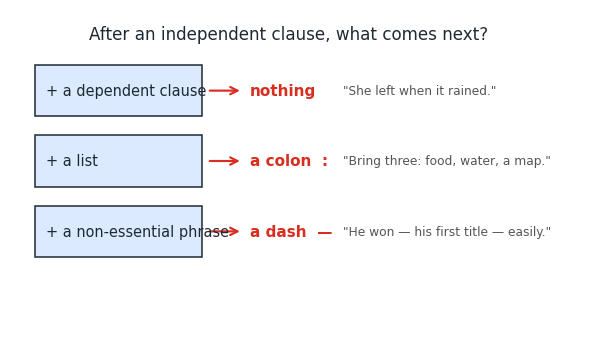
An independent clause is a complete sentence, and what you place after it depends on what comes next.
If a dependent clause follows the independent one, use no punctuation. In "She left the office when the storm began", the dependent clause "when the storm began" needs no comma before it. Adding a comma there would be incorrect.
If a list follows, introduce it with a colon. In "Pack three things: food, water, and a map", the colon comes after the complete independent clause and announces the list. The part before the colon must be able to stand on its own.
If a non-essential phrase follows, set it off with a dash. In "They reached the summit — the highest in the range — at dawn", the dashes mark extra information you could remove. A dash also works to add such a phrase at the very end of a sentence.
Worked examples
Which choice correctly punctuates the sentence? "He kept running ______ even though his legs were exhausted." (A) no punctuation (B) a comma "Even though his legs were exhausted" is a dependent clause following the independent clause, and no comma belongs before it. So (A), no punctuation, is correct.
Which choice correctly punctuates the sentence? "The kit contains everything you need ______ a tent, a stove, and a lantern." (A) a colon (B) a comma The first part is a complete independent clause, and a list follows, which calls for a colon. So (A), a colon, is correct.
Which choice correctly punctuates the sentence? "The team finally won the championship ______ its first in twenty years." (A) a dash (B) a colon "Its first in twenty years" is a non-essential phrase adding extra detail, which a dash sets off; a colon would wrongly signal a list. So (A), a dash, is correct.
Is this one of the topics costing you points?
Take the free 10-question diagnostic for a predicted SAT score and a breakdown of which domains are costing you points.