Boundaries
How the SAT tests this, with worked examples — plus the 8 skills it covers. Free to read, no account needed.
Boundaries questions are punctuation questions. Nearly all of them come down to one test: is each side of the punctuation a complete sentence — something that could stand alone?
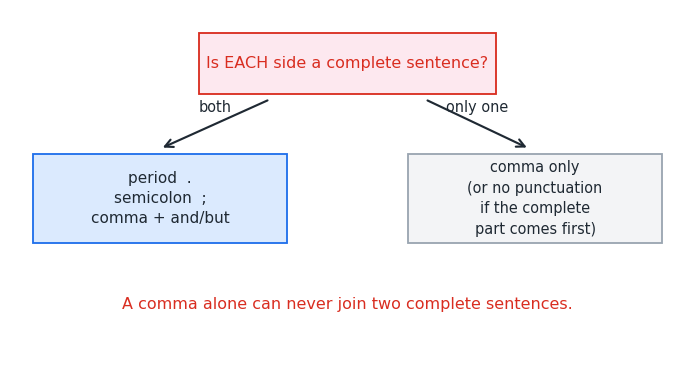
Work through the two questions below and the pattern will do more for you than any list of rules.
Worked examples
In astronomy, the term "zombie star" refers to a star that appears to have died in a supernova explosion but somehow reignites and continues to shine. Like a zombie rising from the dead, a zombie star is not truly gone ________ defies expectations by returning to life.
Which choice completes the text so that it conforms to the conventions of Standard English?
- A; instead, it
- B, instead it
- C, instead, it
- Dinstead it
Cover the blank and read each side. "A zombie star is not truly gone" is a complete sentence. "It defies expectations by returning to life" is also complete. Two complete sentences need a full stop, a semicolon, or a comma plus a joining word like and or but.
(A) is correct: the semicolon joins the two, and instead is set off by the comma that follows it.
(B) and (C) both use a comma alone between two complete sentences. That is a comma splice, and it is the error this topic tests most often.
(D) runs the two sentences together with no punctuation at all.
Silent movies were a popular form of entertainment _______ relied heavily on visual storytelling and exaggerated gestures to convey emotion.
Which choice completes the text so that it conforms to the conventions of Standard English?
- Ain the early 20th century, they
- Bin the early 20th century: they
- Cin the early 20th century they
- D,in the early 20th century, they
Again, check both sides. "Silent movies were a popular form of entertainment in the early 20th century" is complete, and "they relied heavily on visual storytelling" is complete. What follows also explains what came before.
(B) is correct: a colon requires a complete sentence in front of it, which we have, and it introduces the explanation that follows.
(A) is a comma splice between two complete sentences.
(C) joins them with nothing, creating a run-on.
(D) puts a comma before a phrase that needs none, and still leaves a splice.
Notice that the first question wanted a semicolon and this one wants a colon. Both need a complete sentence on the left; the colon additionally signals that an explanation follows.
Is boundaries costing you points?
Take the free 10-question diagnostic for a predicted SAT score and a breakdown of which domains are costing you points.