Finding zeros of a function
An SAT Math micro-topic under Polynomial and other nonlinear graphs (Advanced Math). Free to read — no account needed.
A zero of a function is any input for which . Because the output is zero there, the graph of the function crosses or touches the -axis at each zero.
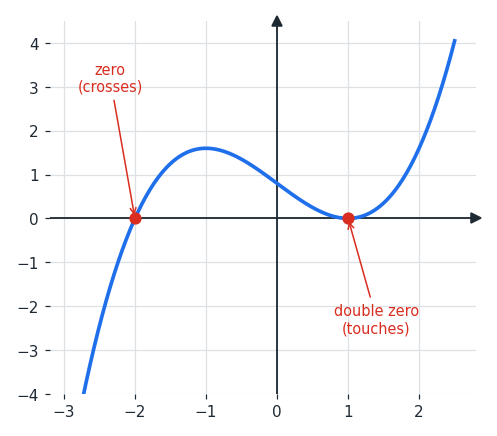
The figure shows both kinds. At one zero the curve passes straight through the axis (a simple zero); at another it just touches and turns back — a double zero, which happens when a factor appears twice.
To find zeros from factors, set each factor to zero. For , the zeros are and . Even though appears twice, counts as one distinct zero (a double zero).
This is the factor idea in reverse: if is a factor of a polynomial, then is a zero, because substituting makes that factor . So if is a factor, set to get the zero .
Worked examples
Find the zeros of .
Set each factor to zero: or .
So the zeros are and .
Set each factor to zero: or .
So the zeros are and .
How many distinct zeros does have?
Set each distinct factor to zero: , , , .
Repeated factors still give one value each, so there are distinct zeros.
Set each distinct factor to zero: , , , .
Repeated factors still give one value each, so there are distinct zeros.
Find the zeros of .
Factor by grouping: .
The zeros are , , and .
Factor by grouping: .
The zeros are , , and .
Is this one of the topics costing you points?
Take the free 10-question diagnostic for a predicted SAT score and a breakdown of which domains are costing you points.