An SAT Math micro-topic under Polynomial and other nonlinear graphs (Advanced Math). Free to read — no account needed.
A function is undefined at any input that leads to an impossible operation. The two you meet most often are dividing by zero and taking the square root of a negative number.
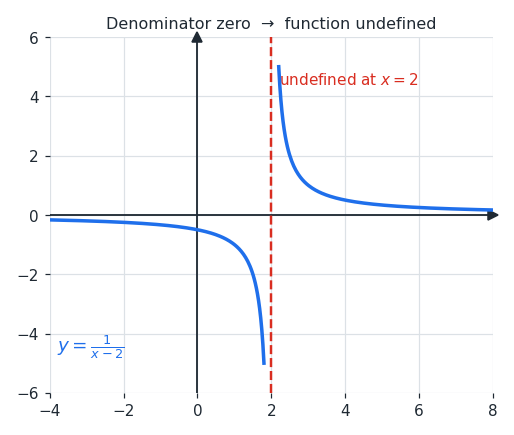
Division by zero is never allowed. So a fraction ba is undefined whenever its denominator b=0. To find the forbidden inputs, set the denominator equal to zero and solve.
An even root of a negative number is also undefined (as a real number). So in 2x+3, the inside must be zero or positive: 2x+3≥0. And an equation like 2x+3=−3 has no solution, because a square root is never negative.
Watch out when a factor cancels. x+1(x+1)(x−3) simplifies to x−3, but it is still undefined at x=−1, because that made the original denominator zero. Cancelling hides the problem but does not remove it.
The domain of a function is all the inputs that are allowed. So you build it by starting with every number and then removing the values that cause division by zero or a negative under a square root.
Worked examples
For what value of x is x−32 undefined? A fraction is undefined when its denominator is zero. Setting x−3=0 gives x=3, so the expression is undefined at x=3.
Which values must be excluded from the domain of x(2x−3)2? The denominator is zero when x=0 or when 2x−3=0. Solving the second gives x=23. So x=0 and x=23.
Does 3x−6=−4 have any real solution? A square root is always zero or positive, so it can never equal −4. Therefore no real value of x works.
Is this one of the topics costing you points?
Take the free 10-question diagnostic for a predicted SAT score and a breakdown of which domains are costing you points.