An SAT Math micro-topic under Polynomial and other nonlinear graphs (Advanced Math). Free to read — no account needed.
The zeros of a polynomial are the x-values where its graph touches or crosses the x-axis. How the graph behaves at a zero depends on whether that zero is single, double, or higher.
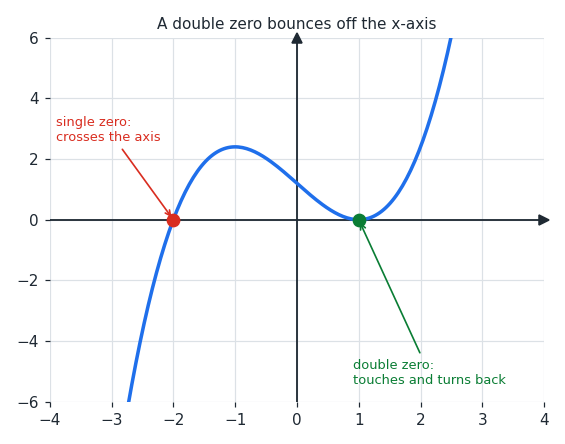
At a single zero, the graph passes straight through the axis. It comes from one factor like (x+2), and the curve is on one side of the axis before the zero and the other side after it. This is the ordinary "crossing" behaviour.
At a double zero, the graph touches the axis and turns back without crossing. It comes from a squared factor like (x−1)2, so the curve dips down to the axis and bounces back up (or peaks up and comes back down). Changing direction right at the zero is the signature of a double zero.
So to read a polynomial graph, note where it meets the axis and how it behaves there. A clean crossing signals a single zero; a touch-and-turn signals a double zero. This lets you match a graph to its factored form, since each squared factor produces a bounce.
Worked examples
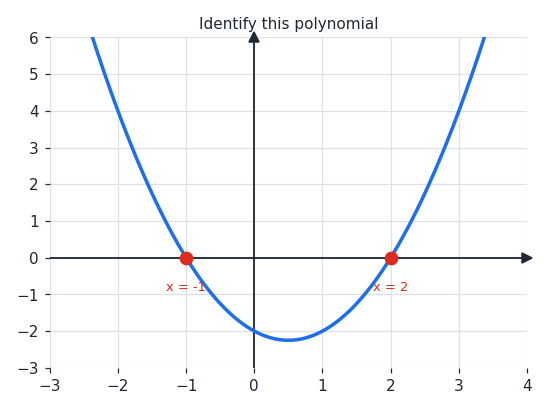
The graph below is a parabola. Which polynomial does it represent? (A) (x+1)(x−2) (B) (x−1)(x+2) The graph crosses the x-axis at x=−1 and x=2, so its factors are (x+1) and (x−2). Choice (A) has exactly these factors, so (A) is correct.
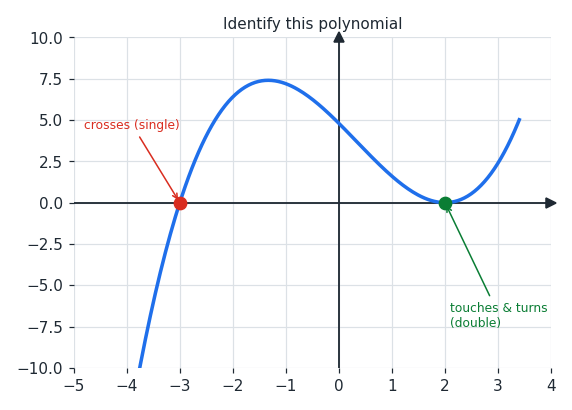
The graph below is a cubic. Which polynomial does it represent? (A) (x+3)(x−2)2 (B) (x+3)(x−2) The graph crosses at x=−3 but only touches and turns at x=2, so x=2 is a double zero that needs a squared factor. Choice (A) has (x−2)2, so (A) is correct.
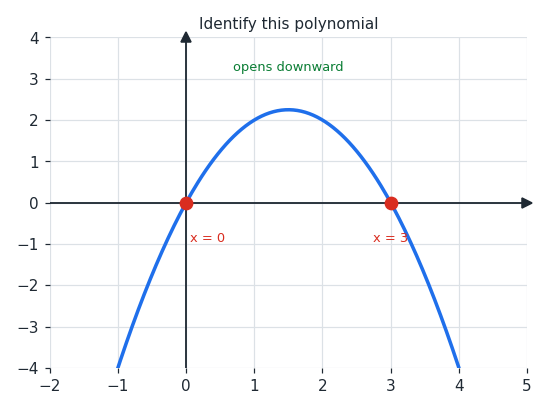
The graph below is a downward parabola. Which polynomial does it represent? (A) −x(x−3) (B) x(x−3) The graph crosses at x=0 and x=3 and opens downward, so the leading coefficient must be negative. Choice (A) carries the negative sign, so (A) is correct.
Is this one of the topics costing you points?
Take the free 10-question diagnostic for a predicted SAT score and a breakdown of which domains are costing you points.