An SAT Math micro-topic under Polynomial and other nonlinear graphs (Advanced Math). Free to read — no account needed.
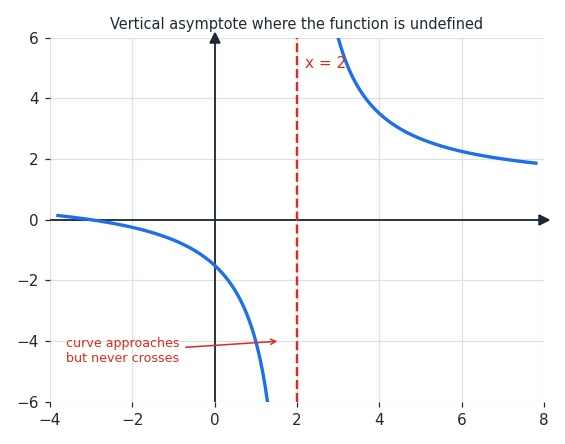
A vertical asymptote is a vertical line that a graph approaches ever more closely without ever crossing it. It occurs at an x-value where the function blows up because it is undefined there.
For a rational function, "undefined" means the denominator equals 0. In f(x)=x−2x+3, the denominator x−2 is 0 when x=2, so the graph has a vertical asymptote at x=2. Near x=2 the curve shoots up or down toward the line but never meets it.
To read an asymptote off a graph, find the vertical line the curve hugs. If two branches of the graph rush toward the line x=2 from either side, that line is the vertical asymptote. Reading it directly lets you match a graph to the function that produces it.
In general form f(x)=x+bx+a, set the denominator to zero to locate the asymptote. Since x+b=0 gives x=−b, the vertical asymptote is x=−b, regardless of a. So if b<0, the asymptote is at a positive x-value, and if b>0, it is at a negative one.
Worked examples
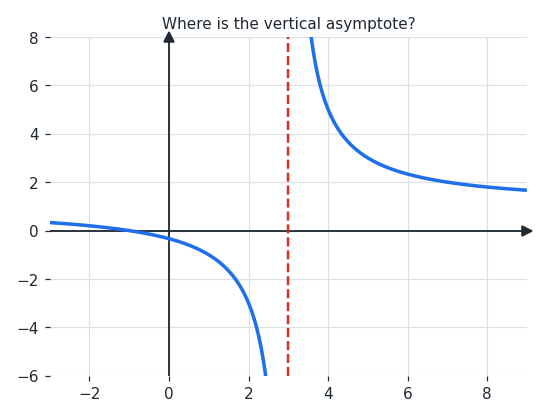
The graph below has a vertical asymptote. What is the equation of the vertical asymptote? (A) x=3 (B) x=−3 The two branches of the graph rush toward the vertical line at x=3 without ever crossing it. Choice (A), x=3, is the vertical asymptote, so (A) is correct.
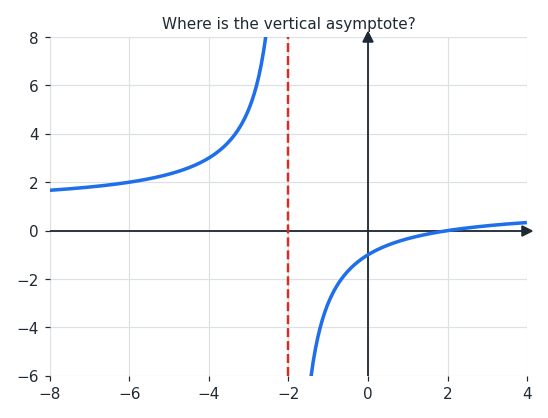
The graph below has a vertical asymptote. What is its equation? (A) x=2 (B) x=−2 The curve blows up around the vertical line x=−2, approaching it from both sides but never touching it. Choice (B), x=−2, is the vertical asymptote, so (B) is correct.
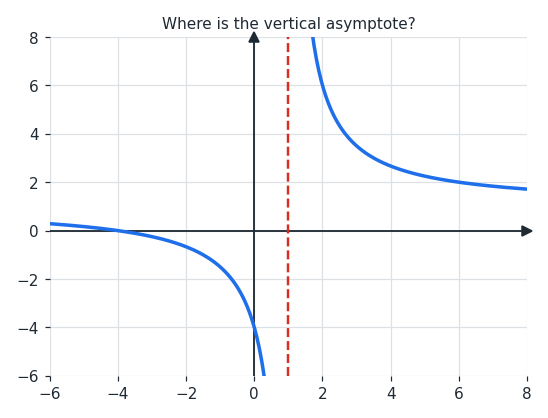
The rational function graphed below has a vertical asymptote. Where is it? (A) x=1 (B) x=−1 The graph approaches the vertical line x=1 ever more closely but never crosses it. Choice (A), x=1, is the vertical asymptote, so (A) is correct.
Is this one of the topics costing you points?
Take the free 10-question diagnostic for a predicted SAT score and a breakdown of which domains are costing you points.