Slope of 2 lines
An SAT Math micro-topic under Graphs of linear equations and functions (Algebra). Free to read — no account needed.
The slopes of two lines tell you how the lines are related.
Equal slopes mean the lines are parallel.
Slopes that multiply to mean the lines are perpendicular.
Equal slopes mean the lines are parallel.
Slopes that multiply to mean the lines are perpendicular.
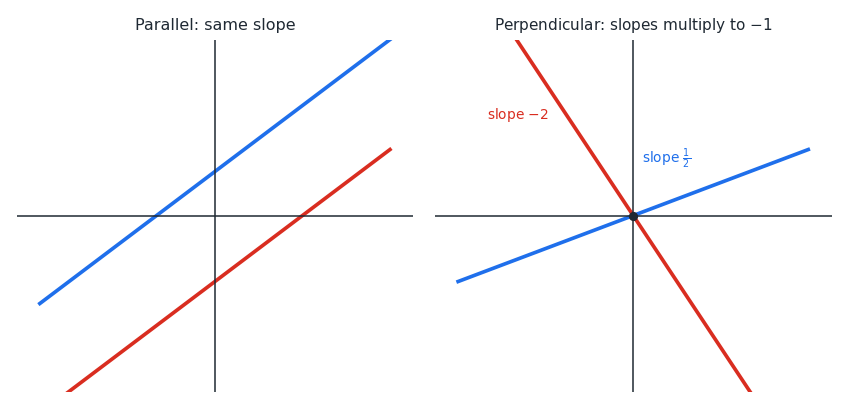
The figure shows both cases.
Parallel lines rise at the same rate, so they stay the same distance apart.
Perpendicular lines meet at a right angle, and their slopes multiply to .
Parallel lines rise at the same rate, so they stay the same distance apart.
Perpendicular lines meet at a right angle, and their slopes multiply to .
To get a perpendicular slope, flip the fraction and change the sign.
The perpendicular slope to is .
Check: .
The perpendicular slope to is .
Check: .
A parallel line just copies the slope.
A line parallel to also has slope .
The intercept can differ, but the slope must match.
A line parallel to also has slope .
The intercept can differ, but the slope must match.
Worked examples
A line has slope . What is the slope of a line perpendicular to it?
Flip to and negate it.
So the perpendicular slope is .
Flip to and negate it.
So the perpendicular slope is .
The line is given. What is the slope of any line parallel to it?
Parallel lines have equal slopes.
So the parallel slope is .
Parallel lines have equal slopes.
So the parallel slope is .
A radius has slope . What is the slope of the tangent line, which is perpendicular to it?
Flip to and negate it.
So the tangent slope is .
Flip to and negate it.
So the tangent slope is .
Is this one of the topics costing you points?
Take the free 10-question diagnostic for a predicted SAT score and a breakdown of which domains are costing you points.