Slope of a line
An SAT Math micro-topic under Graphs of linear equations and functions (Algebra). Free to read — no account needed.
Slope tells you how quickly a line rises or falls.
It is the change in divided by the change in , or rise over run.
For two points and , the slope is .
It is the change in divided by the change in , or rise over run.
For two points and , the slope is .
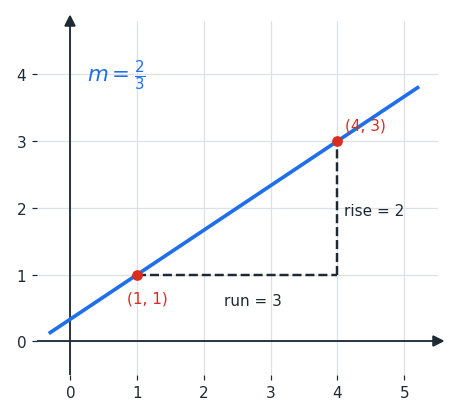
In the figure, moving from one point to the other, the run is the horizontal change and the rise is the vertical change.
The slope is the rise divided by the run.
Here that is .
The slope is the rise divided by the run.
Here that is .
To find the slope from two points, subtract the -values and divide by the difference of the -values.
For and : .
Order does not matter, as long as you subtract in the same order on top and bottom.
For and : .
Order does not matter, as long as you subtract in the same order on top and bottom.
A positive slope rises from left to right, and a negative slope falls from left to right.
A larger number, positive or negative, means a steeper line.
A slope of zero is a flat, horizontal line.
A larger number, positive or negative, means a steeper line.
A slope of zero is a flat, horizontal line.
Worked examples
What is the slope of the line through and ?
Slope is .
So the slope is .
Slope is .
So the slope is .
A line has -intercept and -intercept . What is its slope?
Use the two points: .
So the slope is .
Use the two points: .
So the slope is .
As increases by , decreases by . What is the slope?
Slope is the change in over the change in : .
So the slope is .
Slope is the change in over the change in : .
So the slope is .
Is this one of the topics costing you points?
Take the free 10-question diagnostic for a predicted SAT score and a breakdown of which domains are costing you points.