Area and volume
How the SAT tests this, with worked examples — plus the 4 skills it covers. Free to read, no account needed.
The SAT gives you most of these formulas, so the work is choosing the right one and substituting carefully — not memorising.
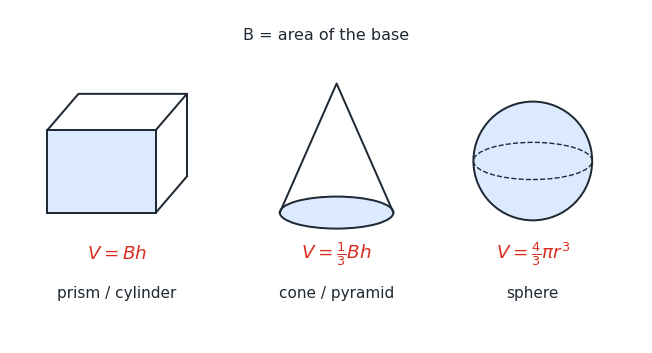
Notice the pattern. A prism or cylinder is base area times height, . A cone or pyramid is exactly one third of the prism that would contain it, . The sphere stands apart with .
So the real question is usually what is. For a cylinder the base is a circle, giving ; for a rectangular prism it is a rectangle, giving .
Surface area is the total area of every face, which for a prism means unfolding it: two bases plus the sides. Questions often ask for one and offer the other as a trap.
The most tested idea here is scaling. If every length of a solid is multiplied by , areas multiply by and volumes by . Doubling the radius of a sphere multiplies its volume by , not .
Finally, watch the units. Lengths in centimetres give areas in and volumes in , and a question that mixes metres with centimetres is testing whether you converted first.
Worked examples
A cylinder has radius and height . Find its volume.
The base is a circle, so
The base is a circle, so
A cone and a cylinder share the same base and height. How do their volumes compare?
- AThe cone is half the cylinder.
- BThe cone is one third of the cylinder.
The cone formula carries the factor {
frac}, so (B) is correct.
frac}, so (B) is correct.
A sphere's radius is tripled. What happens to its volume?
Volume scales with the cube of the length factor
Volume scales with the cube of the length factor
so the volume becomes times larger. Answer choices will offer and for the students who scaled lengths or areas instead.
Is area and volume costing you points?
Take the free 10-question diagnostic for a predicted SAT score and a breakdown of which domains are costing you points.