Congruence, similarity, and angle relationships
How the SAT tests this, with worked examples — plus the 3 skills it covers. Free to read, no account needed.
Two figures are congruent when they are identical in both shape and size. They are similar when they have the same shape but different sizes. Similarity is what the SAT tests most, because it lets the question give you three lengths and ask for a fourth.
In similar figures, every pair of corresponding angles is equal and every pair of corresponding sides is in the same ratio. That shared ratio is the scale factor.
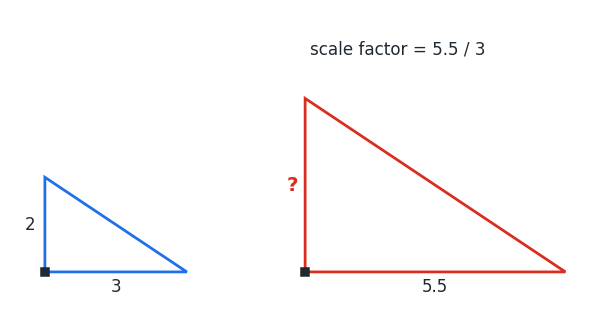
Set up a proportion using corresponding sides and solve
The hard part is almost never the algebra. It is matching the sides correctly, which you do by matching the angles first.
Two facts are worth memorising because they short-circuit most problems. If two angles of one triangle equal two angles of another, the triangles are similar. And if the scale factor for lengths is , then areas scale by , not by .
Angle questions lean on a small set of rules applied in sequence. Angles around a point total , angles on a straight line total , vertically opposite angles are equal, and a line crossing parallel lines creates equal corresponding angles.
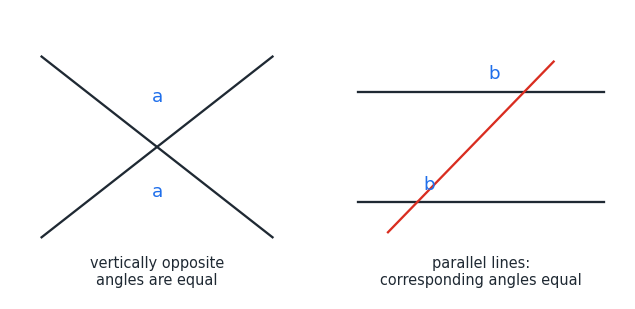
When a diagram looks crowded, label every angle you can deduce with one rule, then look again. Nearly every SAT angle question falls apart after two or three such steps.
Worked examples
Two similar triangles have bases and . The smaller has height .
What is the height of the larger triangle?
The scale factor is , so the height scales the same way
What is the height of the larger triangle?
The scale factor is , so the height scales the same way
Note that you never needed the angles — once similarity is given, one ratio governs every length.
Two similar rectangles have sides in the ratio . The smaller has area .
What is the area of the larger?
- A
- B
Areas scale by the square of the length ratio, so the factor is {
left(
frac
right)^2 = 6.25} and the area is {12
times 6.25 = 75}. Choice (A) is the trap: it scales by instead of , so (B) is correct.
left(
frac
right)^2 = 6.25} and the area is {12
times 6.25 = 75}. Choice (A) is the trap: it scales by instead of , so (B) is correct.
Two lines cross and one angle measures .
Find the other three angles.
The vertically opposite angle is also . Each remaining angle sits on a straight line with , so it is . The four angles are , and they total as expected.
Find the other three angles.
The vertically opposite angle is also . Each remaining angle sits on a straight line with , so it is . The four angles are , and they total as expected.
Is congruence, similarity, and angle relationships costing you points?
Take the free 10-question diagnostic for a predicted SAT score and a breakdown of which domains are costing you points.