Factoring quadratic and polynomial expressions
How the SAT tests this, with worked examples — plus the 6 skills it covers. Free to read, no account needed.
Factoring rewrites a sum as a product, which matters because a product equalling zero tells you something a sum never can: at least one factor must be zero.
For , you need two numbers that multiply to and add to . The area model shows why.
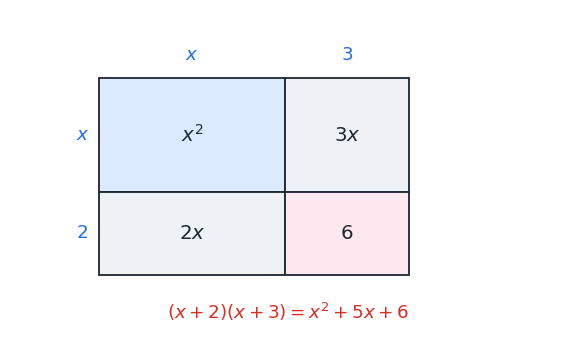
The two inner rectangles are the terms, and they add to give the middle term, while the corner rectangle is the constant. So gives because and .
Always check for a common factor first. looks awkward until you take out the , leaving , which factors easily.
Two patterns are worth recognising on sight. The difference of squares, , and the perfect square, . Both appear far more often than random quadratics.
When the leading coefficient is not , factoring by grouping works: split the middle term into two parts that multiply to and add to , then factor in pairs.
Worked examples
Factor .
Find two numbers multiplying to and adding to : those are and
Find two numbers multiplying to and adding to : those are and
Factor .
- A
- B
This is a difference of squares, since , so (A) is correct. (B) would expand to .
Solve .
Factor first, then use the fact that a product is zero only if a factor is
Factor first, then use the fact that a product is zero only if a factor is
This is why factoring is worth doing: it converts one quadratic into two trivial linear equations.
Is factoring quadratic and polynomial expressions costing you points?
Take the free 10-question diagnostic for a predicted SAT score and a breakdown of which domains are costing you points.