Graphs of linear systems and inequalities
How the SAT tests this, with worked examples — plus the 3 skills it covers. Free to read, no account needed.
An inequality describes a region of the plane rather than a line. Graph the boundary line first, then decide which side satisfies the inequality.
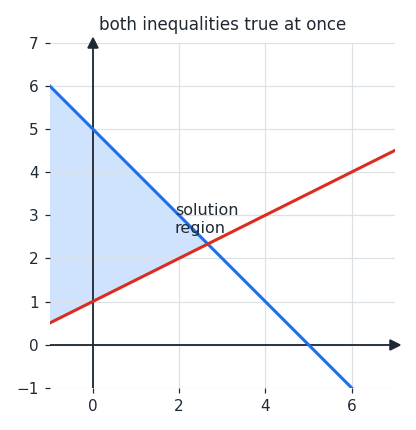
The boundary is solid when the inequality includes equality, as in or , and dashed when it is strict, as in or . That detail is tested directly.
To choose the side, test a point not on the line — whenever possible. If it satisfies the inequality, shade its side; if not, shade the other.
For a system of inequalities, the solution is where all the shaded regions overlap, so a point is a solution only if it satisfies every inequality at once. Questions often give a point and ask whether it qualifies, which you answer by substituting into each in turn.
A quick shortcut for alone on the left: means shade above the line, means shade below.
Worked examples
Is a solution of and ?
Check each in turn: is true, and is true. Both hold, so yes.
Check each in turn: is true, and is true. Both hold, so yes.
Should the boundary of be solid or dashed?
- ASolid
- BDashed
The inequality is strict, so points on the line are not included and the boundary is dashed, making (B) correct.
Is graphs of linear systems and inequalities costing you points?
Take the free 10-question diagnostic for a predicted SAT score and a breakdown of which domains are costing you points.