Linear and quadratic systems
How the SAT tests this, with worked examples — plus the 4 skills it covers. Free to read, no account needed.
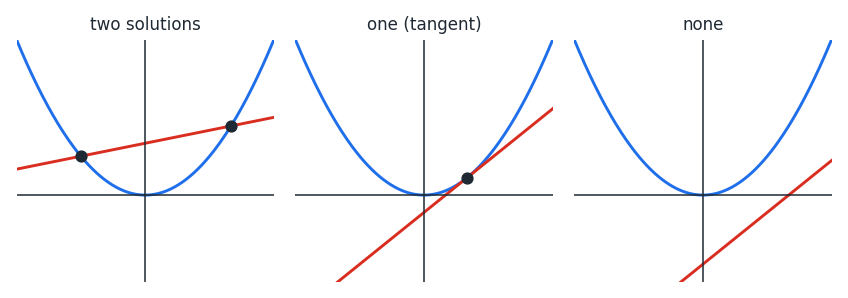
Here one equation is a line and the other a parabola, and the solutions are the points where they meet. A line can cut a parabola twice, touch it once, or miss it entirely.
The method is substitution every time. Put the linear expression for into the quadratic, collect everything on one side, and you have an ordinary quadratic equation to solve.
How many solutions there are is decided by the discriminant of that resulting quadratic. Positive gives two intersections, zero gives exactly one — the tangent case — and negative gives none.
That is why questions asking for the value of a constant making the system have exactly one solution are really asking you to set the discriminant to zero and solve.
Remember to finish the job. Solving gives you ; the question usually wants the point, so substitute back into the linear equation to get .
Worked examples
Solve and .
Substitute and collect
Substitute and collect
which factors to give and . Substituting back gives the points and .
For what value of does and meet exactly once?
Substituting gives , whose discriminant is . One solution needs the discriminant to be zero
Substituting gives , whose discriminant is . One solution needs the discriminant to be zero
Is linear and quadratic systems costing you points?
Take the free 10-question diagnostic for a predicted SAT score and a breakdown of which domains are costing you points.