Unit Conversion
How the SAT tests this, with worked examples — plus the 4 skills it covers. Free to read, no account needed.
Conversion questions are solved by multiplying by fractions that equal one, arranged so the unwanted units cancel.
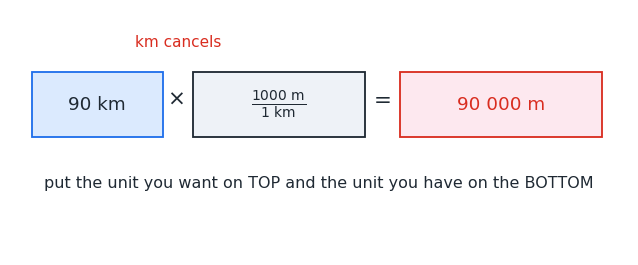
The rule for building each fraction is simple: put the unit you want on top and the unit you have on the bottom. Then the unit you have cancels, exactly as a common factor cancels in algebra.
Chains work the same way. To convert kilometres per hour into metres per second, multiply by and then by , and both unwanted units disappear.
When a question involves area or volume, the conversion factor must be raised to the same power. There are centimetres in a metre but square centimetres in a square metre.
If you are unsure whether to multiply or divide, write the units out and let them decide. The arrangement that cancels correctly is the right one, and it needs no judgement.
Worked examples
Convert kilometres to metres.
Want metres on top, kilometres on the bottom
Want metres on top, kilometres on the bottom
Convert km/h into m/s.
Chain the two conversions so both unwanted units cancel
Chain the two conversions so both unwanted units cancel
How many square centimetres are in square metres?
- A
- B
The length factor is , so the area factor is , giving . (B) is correct; (A) uses the length factor by mistake.
Is unit conversion costing you points?
Take the free 10-question diagnostic for a predicted SAT score and a breakdown of which domains are costing you points.