An SAT Math micro-topic under Radicals and rational exponents (Advanced Math). Free to read — no account needed.
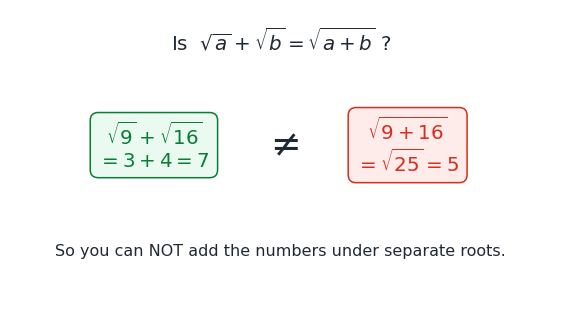
The most important warning first: a square root does not split over addition. So a+b is not the same as a+b. To see it, 9+16=3+4=7, but 9+16=25=5.
You can add radicals when they are like radicals — they have the same number under the root. Treat the root like a variable: 23+53=73, exactly the way 2x+5x=7x. Unlike radicals, such as 3+5, cannot be combined into one term.
Sometimes radicals only look unlike until you simplify them. For example, 12 simplifies to 23, because 12=4×3 and 4=2. So 12+3=23+3=33.
In a radical equation, it helps to treat the whole root as a single quantity. For 6−3m=5m+2, think of m as one thing and collect it on one side. Subtracting 5m and 6 from both sides gives −8m=−4, so m=21 and m=41.
Worked examples
Simplify 35+45. These are like radicals, both with 5, so add the numbers in front. So 35+45=75.
Simplify 8+2. First simplify 8=4×2=22. Now the terms are like radicals: 22+2=32.
Solve 4x=x+9. Treat x as a single quantity and collect it: subtract x from both sides to get 3x=9. So x=3, which gives x=9.
Is this one of the topics costing you points?
Take the free 10-question diagnostic for a predicted SAT score and a breakdown of which domains are costing you points.