An SAT Math micro-topic under Radicals and rational exponents (Advanced Math). Free to read — no account needed.
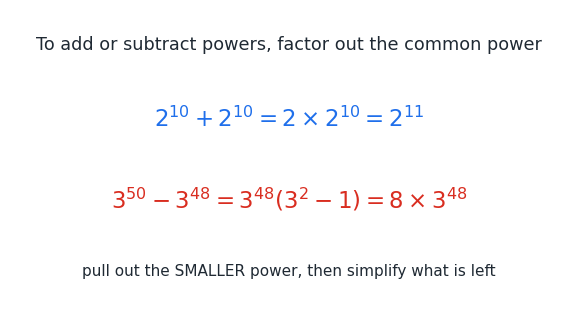
Adding powers is a common trap. You add exponents only when you multiply like bases (23×24=27). When you add them, the exponents do not combine — 210+210 is not 220.
When the two powers are equal, adding them just doubles one. So 210+210=2×210, and since 2=21, that is 211. In the same way, three copies would give 3×210.
When the powers differ, factor out the smaller one. For 350−348, pull out 348: 350−348=348(32−1). Then 32−1=8, so the whole thing is 8×348.
This shows up in evenly spaced sequences, where each term is a fixed power apart. If S7−S6=210 and S6=210, then S7=210+210=211. Each new term is found by adding, then factoring out the common power.
Worked examples
Simplify 58+58. The two powers are equal, so adding them doubles one: 58+58=2×58. So the answer is 2×58.
Simplify 220−218. Factor out the smaller power, 218: 220−218=218(22−1). Since 22−1=3, the result is 3×218.
In a sequence, S8−S7=210 and S7=211. What is S8? Add: S8=211+210, and factor out 210 to get 210(2+1). So S8=3×210.
Is this one of the topics costing you points?
Take the free 10-question diagnostic for a predicted SAT score and a breakdown of which domains are costing you points.