An SAT Math micro-topic under Radicals and rational exponents (Advanced Math). Free to read — no account needed.
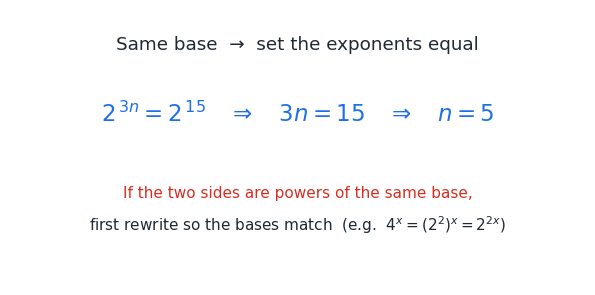
An equation with indices (exponents) is easiest to solve when both sides share the same base. If bsomething=bsomething else and the base b is the same, then the two exponents must be equal.
So you just set the exponents equal and solve the simpler equation. For 52x=58, the base is 5 on both sides, so 2x=8, which gives x=4. The exponents behave like an ordinary equation once the bases match.
Often the two sides look different but can be made to share a base. Since 4=22, the equation 4x=26 becomes (22)x=26, that is 22x=26. Now the bases match, so 2x=6 and x=3.
The same idea works with inequalities as long as the base is greater than 1. For 23n>213 the bases match, so 3n>13, giving n>313. The smallest whole number that satisfies this is n=5.
Worked examples
Solve 22x=210. The base is 2 on both sides, so the exponents are equal: 2x=10. Dividing by 2, x=5.
Solve 9x=38. Rewrite the left side with base 3: since 9=32, 9x=(32)x=32x. Now 32x=38, so 2x=8 and x=4.
If 7m+1=75, what is m? The base is 7 on both sides, so the exponents are equal: m+1=5. Subtracting 1, m=4.
Is this one of the topics costing you points?
Take the free 10-question diagnostic for a predicted SAT score and a breakdown of which domains are costing you points.