An SAT Math micro-topic under Radicals and rational exponents (Advanced Math). Free to read — no account needed.
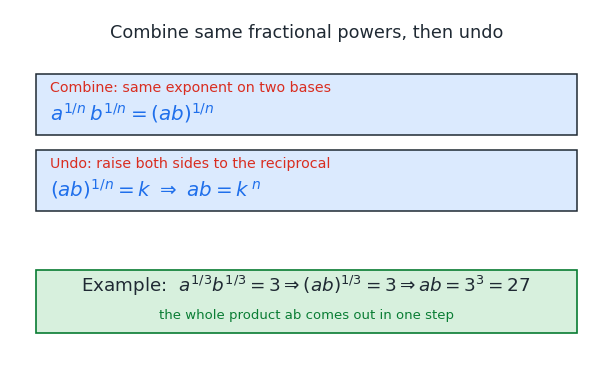
A common advanced question gives you two variables tied together by a fractional power and asks for their product. The trick is that the same exponent on two bases combines into one: a1/nb1/n=(ab)1/n.
Once the two bases are combined, you have a single power of the product, which you undo by raising both sides to the reciprocal exponent. For example, if a1/3b1/3=3, then (ab)1/3=3. Cubing both sides gives ab=33=27, so the whole product comes out in one step.
A leading coefficient is just cleared first. Suppose 31x3/4y3/4=1; multiply both sides by 3 to get x3/4y3/4=3, which is (xy)3/4=3. Raising both sides to the reciprocal power 34 gives xy=34/3=333.
So the plan is always the same three moves. First combine the like fractional powers into one power of the product; then, if there is a coefficient, divide it out; finally raise both sides to the reciprocal exponent to free the product. Recognising a1/nb1/n as (ab)1/n is what makes these questions quick.
Worked examples
Find ab if a1/2b1/2=5. Combine the like powers: a1/2b1/2=(ab)1/2, so (ab)1/2=5. Squaring both sides gives ab=52=25.
Find xy if 21x3/4y3/4=4. Multiply both sides by 2: x3/4y3/4=8, which is (xy)3/4=8. Raising both sides to the power 34 gives xy=84/3=(81/3)4=24=16.
Find ab if a2/3b2/3=4. Combine the like powers: (ab)2/3=4. Raising both sides to the power 23 gives ab=43/2=(41/2)3=23=8.
Is this one of the topics costing you points?
Take the free 10-question diagnostic for a predicted SAT score and a breakdown of which domains are costing you points.