An SAT Math micro-topic under Radicals and rational exponents (Advanced Math). Free to read — no account needed.
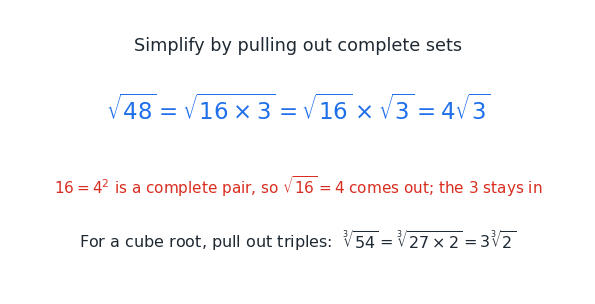
To simplify a radical, split what is inside into a part that forms complete sets and a leftover part. Each complete set comes out of the radical as one factor, and whatever is left stays under it.
For a square root, a complete set is a pair, since a2=a. Take 72: since 72=36×2 and 36 is a perfect square, 72=36×2=62.
For a cube root, a complete set is a triple, since 3a3=a. Take 324: since 24=8×3 and 8=23, 324=38×33=233.
Variables work the same way. For a square root, x5=x4×x=x2x, since x4 is two complete pairs. Pull out as many complete sets as you can, and leave the rest inside.
Worked examples
Simplify 50. Split off a perfect square: 50=25×2, and 25=52. So 50=25×2=52.
Simplify 50x5. Break it into complete pairs and leftovers: 50x5=(25×x4)×(2×x). The pairs come out as 5 and x2, so 50x5=5x22x.
Simplify 324x4. Look for complete triples: 24=23×3 and x4=x3×x. The 23 and x3 come out as 2 and x, leaving 324x4=2x33x.
Is this one of the topics costing you points?
Take the free 10-question diagnostic for a predicted SAT score and a breakdown of which domains are costing you points.