Basic functions
An SAT Math micro-topic under Nonlinear functions (Advanced Math). Free to read — no account needed.
A function is a rule that assigns one output to each input. The notation is not multiplication; it means substitute into the rule wherever the variable appears, then simplify. So if , then .
The input can itself be an expression. To find you first work out the input, , and then substitute.
A function can also be given as a graph. There, is the -coordinate of the point sitting directly above , and the lowest or highest point of the curve gives the function's minimum or maximum.
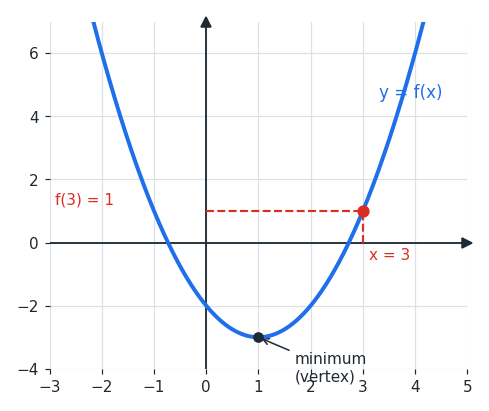
In the figure, to read go up from to the curve and across to the -axis: the value is . The lowest point of the curve, its vertex, is the minimum. One caution: a function does not split across addition. In general — for , , which is not .
Worked examples
If , what is ?
Substitute for everywhere:
.
Substitute for everywhere:
.
If , what is ?
Substitute :
.
On the graph this is the point on the curve above .
Substitute :
.
On the graph this is the point on the curve above .
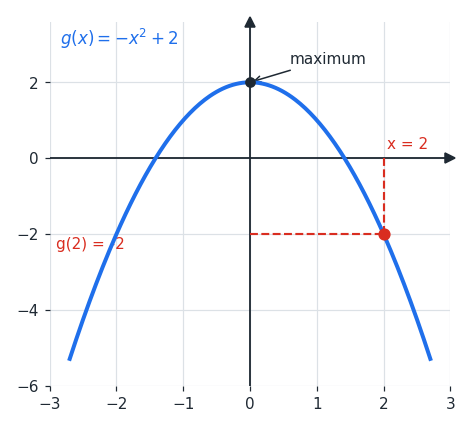
If , what is ?
Substitute :
.
Substitute :
.
If , what is ?
Substitute :
.
Substitute :
.
If , what is ?
Substitute :
.
Substitute :
.
Reading from graphs, suppose .
Then means : read the value of where .
If , then .
Then means : read the value of where .
If , then .
Does for ?
No: ,
but .
They are not the same.
No: ,
but .
They are not the same.
Is this one of the topics costing you points?
Take the free 10-question diagnostic for a predicted SAT score and a breakdown of which domains are costing you points.