An SAT Math micro-topic under Nonlinear functions (Advanced Math). Free to read — no account needed.
A shift moves a graph while keeping its shape the same. Changing the input shifts it sideways, and changing the output shifts it up or down. You can do one or both at once.
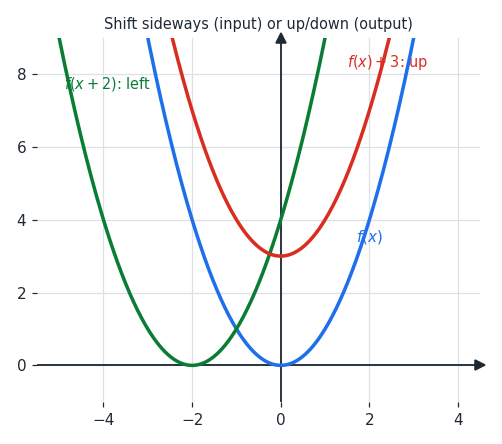
The figure shows a base curve with a horizontal shift and a vertical shift. Changing the input, like f(x+2), moves the graph sideways; adding a constant, like f(x)+3, moves it up. The shape stays exactly the same in both cases.
Adding inside the function moves it left, and subtracting inside moves it right — opposite to what the sign suggests. Adding outside moves it up, and subtracting outside moves it down — just as the sign suggests. So f(x−2)+5 is right 2 and up 5.
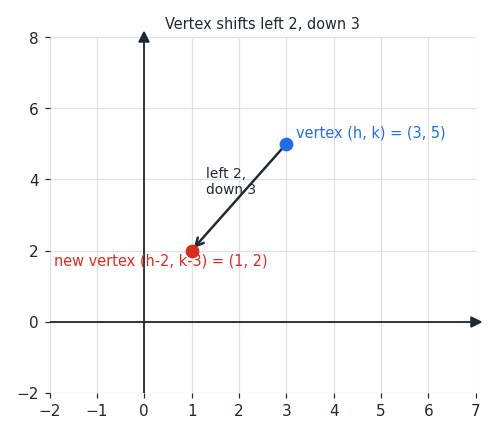
You can combine both shifts, and the vertex moves the same way as every point. If the vertex was at (h,k), then after shifting left 2 and down 3 it is at (h−2,k−3). Tracking the vertex describes the whole shift.
Worked examples
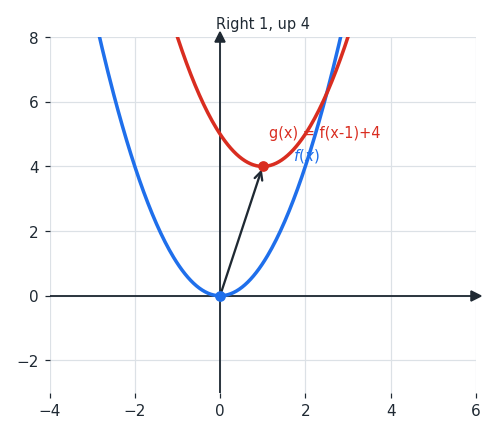
How does g(x)=f(x−1)+4 shift the graph of f(x)? The −1 inside moves it right 1 unit, and the +4 outside moves it up 4 units. So g is f shifted right 1 and up 4.
A vertex is at (h,k). Where is it after shifting 3 units down and 2 units left? Left 2 subtracts 2 from x, and down 3 subtracts 3 from y. So the new vertex is (h−2,k−3).
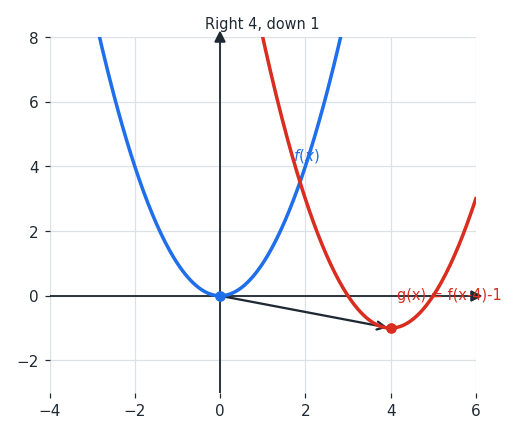
Given g(x)=f(x−4)−1, how is f shifted to get g? The −4 inside moves it right 4 units, and the −1 outside moves it down 1 unit. So g is f shifted right 4 and down 1.
Is this one of the topics costing you points?
Take the free 10-question diagnostic for a predicted SAT score and a breakdown of which domains are costing you points.