An SAT Math micro-topic under Nonlinear functions (Advanced Math). Free to read — no account needed.
Shifting moves a graph without changing its shape. Stretching and reflecting are different: they change how tall the graph is or which way it faces. There are two things to look for — a number multiplying the function, and a minus sign.
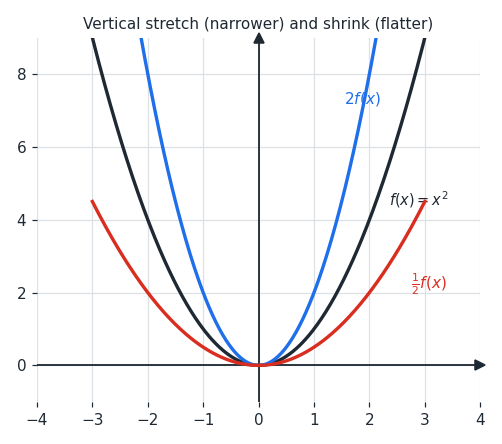
Multiplying the whole function by a number, g(x)=a⋅f(x), is a vertical stretch. Every y-value is multiplied by a, so the points move away from or toward the x-axis. If a>1, the graph is stretched taller, which makes a parabola look narrower. If 0<a<1, the graph is shrunk flatter, which makes a parabola look wider.
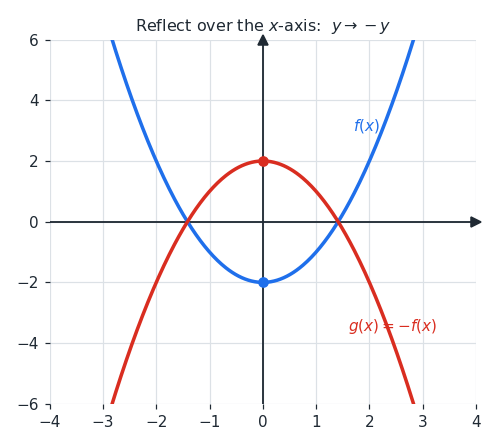
Putting a minus sign in front, g(x)=−f(x), reflects the graph over the x-axis. It flips upside down: every y-value changes sign, so a low point becomes a high point. For a line like y=2x+6, reflecting over the x-axis gives y=−2x−6 — both the slope and the intercept change sign.
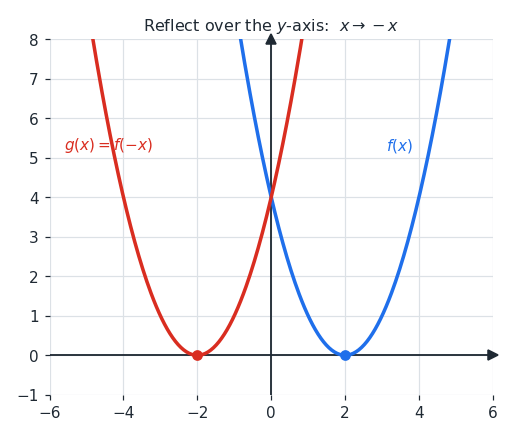
Putting the minus sign inside, on the x, gives g(x)=f(−x), which reflects the graph over the y-axis. It flips left-to-right, like a mirror image. A point that was at x=2 moves to x=−2.
These can combine. For example, g(x)=−f(x+1) means flip f upside down (the minus sign) and shift it left by 1 (the +1 inside). Read the transformations one piece at a time: handle the stretch or flip, then the shift.
Worked examples
How does the graph of g(x)=3f(x) compare with f(x)? Multiplying by 3 is a vertical stretch, since every y-value becomes 3 times as large. So g(x) is f(x) stretched taller (three times as far from the x-axis).
The line y=3x−4 is reflected over the x-axis. What is the new equation? Reflecting over the x-axis replaces y with −y, so −y=3x−4. Solving for y gives y=−3x+4: both the slope and the intercept change sign.
A function f(x) crosses the x-axis at x=2 and x=−3. Where does g(x)=f(−x) cross the x-axis? g(x)=f(−x) reflects the graph over the y-axis, so each x-intercept flips to the opposite sign. So g(x) crosses at x=−2 and x=3.
Is this one of the topics costing you points?
Take the free 10-question diagnostic for a predicted SAT score and a breakdown of which domains are costing you points.