An SAT Math micro-topic under Nonlinear functions (Advanced Math). Free to read — no account needed.
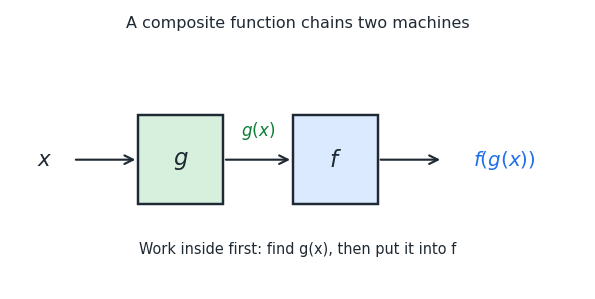
A composite function feeds the output of one function into another. The notation f(g(x)) means "put g(x) in place of the input of f". You always work from the inside out: deal with the inner function first, then the outer one.
To evaluate at a number, find the inner value, then apply the outer function to it. Suppose f(2)=4 and g(x)=2x+1. Then g(f(2))=g(4)=24+1=17.
The same works when the functions have formulas. Let f(x)=ax+2 and g(x)=3x−1. To find f(g(−1)), first g(−1)=3(−1)−1=−4, then f(−4)=a(−4)+2.
You can also compose a function with itself and simplify symbolically. For h(x)=4−2x, the composite h(h(x)) replaces the input of h with h(x): h(h(x))=4−2(h(x))=4−2(4−2x). Multiplying out gives 4−8+4x=4x−4.
Finally, the order of composition matters. In general f(g(x)) is not the same as g(f(x)), because putting g inside f is different from putting f inside g.
Worked examples
Let f(x)=2x+1 and g(x)=x2. What is f(g(3))? Work inside first: g(3)=32=9. Then f(9)=2(9)+1=19.
Let f(x)=3x and g(x)=x+4. What is g(f(2))? Work inside first: f(2)=3(2)=6. Then g(6)=6+4=10.
Let p(x)=3x−1. What is p(p(x))? Replace the input of p with p(x): p(p(x))=3(3x−1)−1. Multiplying out gives 9x−3−1=9x−4.
Is this one of the topics costing you points?
Take the free 10-question diagnostic for a predicted SAT score and a breakdown of which domains are costing you points.