Quadratic and exponential word problems
How the SAT tests this, with worked examples — plus the 4 skills it covers. Free to read, no account needed.
The first decision in these questions is which kind of model the words describe, and one test settles it. If a quantity changes by the same amount each period it is linear; if it changes by the same factor or percentage, it is exponential.
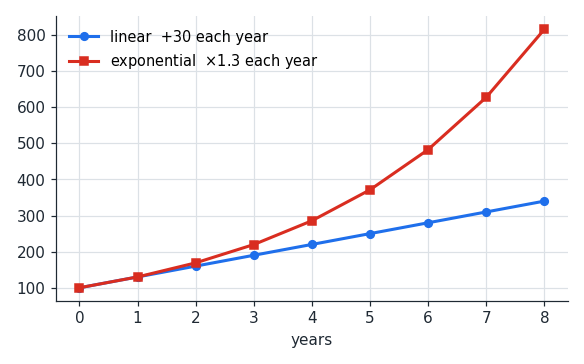
Phrases such as doubles, halves, grows by 8% a year and decays all signal exponential behaviour, written as where is the starting amount and the multiplier. Growth of means ; decay of means .
Quadratic models appear whenever something rises and then falls — a thrown object, a profit that peaks — or when two varying lengths multiply to give an area.
For a quadratic, the vertex answers the most common questions: the maximum height, the time it occurs, the price giving the greatest revenue. The roots answer when the quantity reaches zero, such as when a ball lands.
As always, read what is being asked. A question giving may want the maximum height, the time at that height, or the time it hits the ground — three different parts of the same model.
Worked examples
A population of grows by a year. Write a model for the population after years.
Growth by a percentage is exponential, with multiplier
Growth by a percentage is exponential, with multiplier
A sample of grams halves every years. Write a model.
Halving is a constant factor, and the exponent counts how many -year periods have passed
Halving is a constant factor, and the exponent counts how many -year periods have passed
A ball follows . When does it land?
Landing means , so factor
Landing means , so factor
is the throw, so it lands at seconds. Note the maximum height occurs at , halfway between the roots.
Is quadratic and exponential word problems costing you points?
Take the free 10-question diagnostic for a predicted SAT score and a breakdown of which domains are costing you points.