An SAT Math micro-topic under Center, spread, and shape of distributions (Problem solving and data analysis). Free to read — no account needed.
Standard deviation is a number that tells you how spread out a data set is. It measures how far the values typically sit from the mean (the average). A small standard deviation means the data huddles close to the mean; a large one means it is scattered widely.
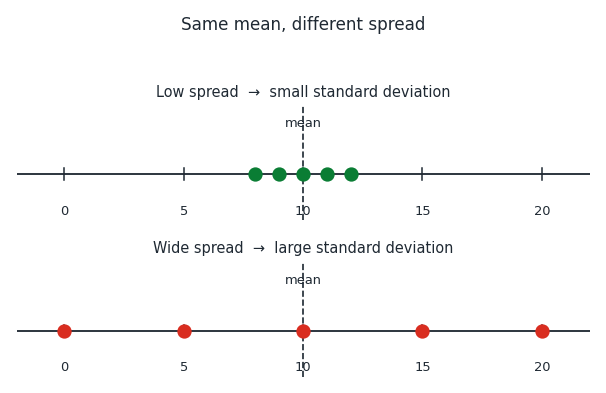
Compare two sets with the same mean of 10. The set 8,9,10,11,12 is packed tightly, so its standard deviation is small. The set 0,5,10,15,20 is spread far apart, so its standard deviation is large.
Standard deviation is never negative, since it measures a distance. It equals exactly 0 in only one case: when every value is identical, so there is no spread at all. That means a value like −3 can never be a standard deviation.
Knowing the mean or median alone does not tell you the standard deviation. Two data sets can share the same mean yet be spread very differently. To compare spread, look at how far the values stretch from the center, not at the average itself.
Worked examples
Which set has the larger standard deviation: 2,2,2,2 or 1,2,3,4? In 2,2,2,2 every value is the same, so there is no spread and the standard deviation is 0. The set 1,2,3,4 is spread out, so it has the larger standard deviation.
Can a data set have a standard deviation of −3? No. Standard deviation measures spread, which is a distance, so it can never be negative. The smallest it can be is 0, and that happens only when every value is identical.
Data Set A has a standard deviation of 5.4, and Data Set B has a standard deviation of 10.2. Which set is more spread out? A larger standard deviation means more spread. Since 10.2>5.4, Data Set B is more spread out.
Is this one of the topics costing you points?
Take the free 10-question diagnostic for a predicted SAT score and a breakdown of which domains are costing you points.