Nonlinear functions
How the SAT tests this, with worked examples — plus the 5 skills it covers. Free to read, no account needed.
A function is a rule that turns an input into an output. is not multiplied by — it is the output of the rule when the input is . Everything in this topic follows from that.
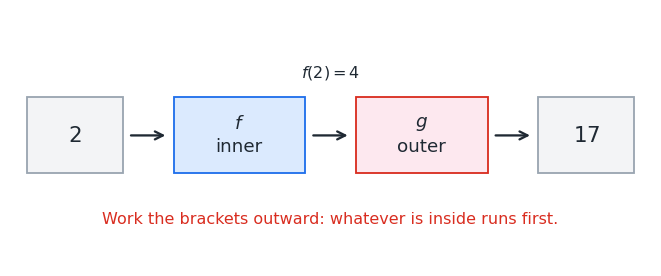
To evaluate, substitute the input wherever appears and compute. To work out a composite such as , start inside the brackets: find first, then feed that answer into .
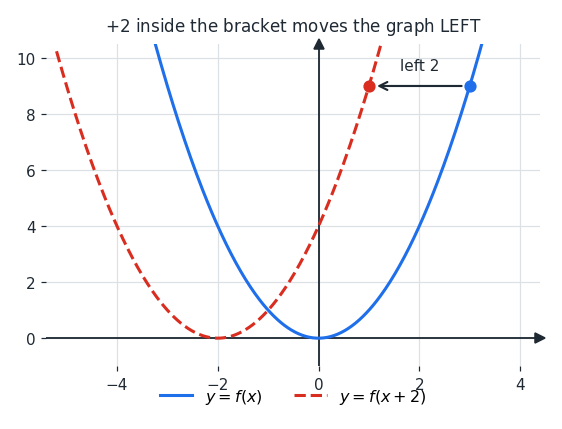
A shift changes where the graph sits. Adding inside the bracket, as in , moves the graph left by — which feels backwards until you see why: the function reaches any given output two units earlier.
Three questions below, one for each of those ideas.
Worked examples
The function is defined as .
What is the value of ?
Substitute everywhere appears, and keep the brackets while you do it: .
Work left to right. , so the first term is . The second is . So .
Two mistakes account for almost every wrong answer here. The first is squaring before applying the minus, reading as . The exponent belongs to the bracket only.
The second is dropping the sign and computing . A negative input carries its sign into every term.
Let {f(x) =
frac} and .
frac} and .
What is the value of ?
- A
- B
- C
- D
Work from the inside out. The inner function is , so find first: {f(2) =
frac =
frac = 4}. Now feed that into the outer function: .
(D) is correct.
(C) is without the — the whole rule for has to be applied, not just the power.
(B) is what you get from , which comes from misreading as .
(A) is , combining both of those slips.
Note that and are different questions. Here and {f(5) =
frac}, nothing like . The order of the brackets is part of the question.
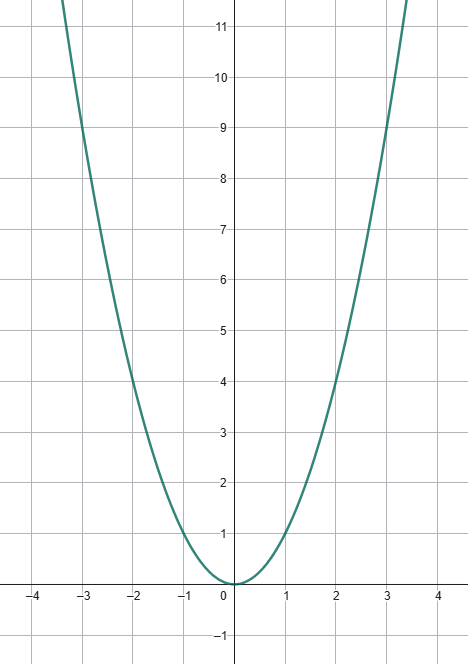
The graph of is shown above. No equation is given — everything you need is on the grid.
If , what is ?
Do not try to identify the equation of the curve. Translate the question into a value you can read off the graph.
Since , putting gives .
So the question is really: how high is the curve at ? Trace up from on the horizontal axis to the curve, then across to the vertical axis. It passes through , so .
The common wrong answer is , from reading the curve at instead — that is , not . The other is , from shifting the wrong way and reading .
Here is the idea worth keeping. is shifted left by , so reaches at whatever reached at . You never needed the equation of either curve.
Is nonlinear functions costing you points?
Take the free 10-question diagnostic for a predicted SAT score and a breakdown of which domains are costing you points.