Radicals and rational exponents
How the SAT tests this, with worked examples — plus the 8 skills it covers. Free to read, no account needed.
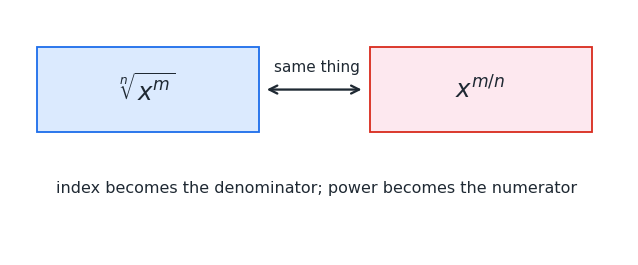
Almost every question here becomes straightforward once you convert radicals into exponents. A root is a fractional power
and once everything is written as a power, the ordinary exponent rules apply.
The rules you need are few: , , and . A negative exponent means a reciprocal, , and a zero exponent gives .
Simplifying a radical means pulling out perfect squares, so . You can only add or subtract radicals once they share the same radicand, exactly as you can only combine like terms.
The one thing that is not true, and is tested constantly, is splitting a root over addition. is not . Roots distribute over multiplication and division only.
Worked examples
Simplify .
Factor out the largest perfect square
Factor out the largest perfect square
Write as a power of .
The index becomes the denominator and the power becomes the numerator
The index becomes the denominator and the power becomes the numerator
Simplify {
sqrt +
sqrt}.
sqrt +
sqrt}.
- A{
sqrt}
(B) {5
sqrt}
Roots do not add across a sum, so (A) is wrong. Simplify each first: {
sqrt = 3
sqrt} and {
sqrt = 2
sqrt}. They are now like terms, giving {5
sqrt}, so (B) is correct.
(B) {5
sqrt}
Roots do not add across a sum, so (A) is wrong. Simplify each first: {
sqrt = 3
sqrt} and {
sqrt = 2
sqrt}. They are now like terms, giving {5
sqrt}, so (B) is correct.
Is radicals and rational exponents costing you points?
Take the free 10-question diagnostic for a predicted SAT score and a breakdown of which domains are costing you points.